
From individual capability to institutional adaptability
This post marks the halfway point in my series on future and change capability in higher education. Rather than introducing a new component of the framework, I offer a brief sensemaking reflection on where this work has come from and why it matters now.
The beginning of this post is for any readers who might have known me and my work for a while and could be thinking, ‘Ruth Bridgstock’s work is about graduate employability, WIL and careers. Why is she writing about institutional change all of a sudden?’
There is logic to it, I promise, and a trajectory of thoughts and practice over a couple of decades.
My interest in future and change capability did begin with individuals, and graduate employability in a certain sense, and since then it has been helpful to align much of my work with employability policy and discourse, although my interests are deeper and broader.
My doctoral research examined how creative practitioners and graduates develop the capacity to navigate uncertain career paths across the lifespan. I was interested in how people manage learning, identity and professional direction in conditions of ambiguity and change. Over time, that inquiry expanded into questions about how individuals learn to lead and navigate innovation and transformation, as individuals and collaboratively.
My interests shifted into curriculum and pedagogy. I moved out of a research intensive career track and became a teaching-and-research academic, to explore whether I could teach the capabilities I was researching. I wanted to know: How might we design educational experiences that cultivate future and change capability in students? What do educators need in order to support, enable, and facilitate? Eventually, as I moved into institutional leadership roles, these questions led to deeper and more challenging ones.
What became apparent was that educational innovation was often being undermined by institutional structures not designed for learning or adaptation. I started to ask: if we truly want students and educators to be adaptable and capable, what must our educational institutions be and do? Significant change was clearly needed.
That progression – from individual capability to educator practice to institutional systems and architecture – has unfolded for me across research, academic leadership and large-scale educational transformation over the last 20 years. After two decades of exploration and experimentation, I have come to the conclusion that without an adaptable HE system with adaptable institutions within it, we cannot effectively enable educators and students to be future and change capable – and future and change capability is vital to our futures.
I no longer believe that future and change capability can be meaningfully developed at the level of the individual student without being actively constrained or enabled by educator practices and capability, and the institutional context.
My timing isn’t incidental. As I argued in post 1, artificial intelligence, funding volatility, workforce transformation, social change and policy reform have intensified the demand for adaptive capability in students and graduates, and at every level of higher education. What began as a question framed in terms of graduate employability has become a broader question about higher education’s sustainability, public value and long-term contribution.
The framework I present in this series integrates several strands: identity and differentiation; permeability and institutional learning; strategy, governance and risk; culture and capability; and engagement with external forces. Together, they outline a model of the future and change capable university.
The model below synthesises the elements developed across this series into an integrated framework for institutional adaptability.
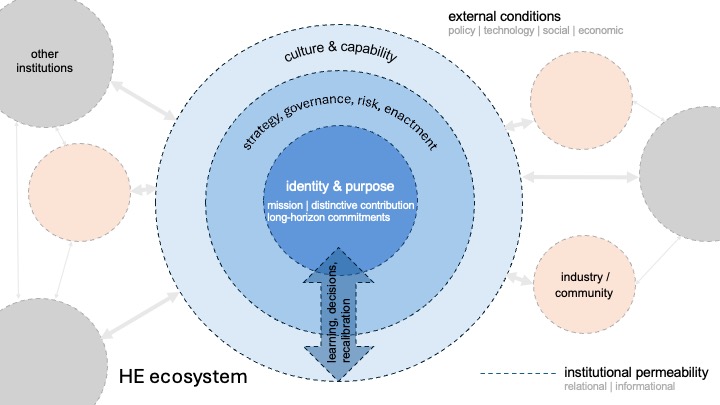
Identity and purpose sit at the core of the institution, anchoring distinctive contribution and long-horizon commitment (post 2). Around that core, strategy, governance, risk and enactment shape how choices are made, sustained and adjusted. Institutional permeability describes how boundaries are intentionally designed: how relationships, information and practice move across academic, organisational and sectoral domains (post 3). Permeability expands what the institution can see; decision architecture determines how insight is translated into action. Learning and recalibration connect experience, evidence and judgement over time. Culture and capability permeate the whole, enabling disciplined interpretation and collective decision-making.
The university operates within a broader ecosystem of policy, professions, technology, industry and community. These conditions cannot be controlled, but they can be engaged with deliberately. Future and change capability develops cumulatively through the alignment of identity, permeability and strategic judgement.
Here I am synthesising and building upon various streams of theoretical work — key contributions that come to mind are Senge’s learning organisations, the double-loop learning of Argyris & Schon, complex adaptive systems, learning ecosystems, innovation systems and triple helix models, and strategic management theory such as Mintzberg & Teece. I’m integrating and extending these for higher education by placing identity, public accountability, and decision architecture at the centre. This is a deliberate departure from capability framings that privilege responsiveness alone; in higher education, adaptability without identity quickly becomes incoherence. Adaptability becomes the cumulative outcome of aligned purpose, selective permeability, disciplined experimentation and governance under constraint.
Three posts in this series remain. They will examine decision architecture and processes in greater depth, explore how culture and capability enable decision-making under uncertainty, and consider how institutions can engage with shifting external conditions without losing coherence.
This model offers an emergent framework for thinking about purposeful institutional adaptability in contemporary higher education.
I invite critique, refinement and collaboration from colleagues who are exploring similar challenges. If the model is useful, I will translate its elements into practical tools to support institutional analysis, disciplined choice and sustained change.


Thank you, Ruth – lovely to see you writing in this space. To me it’s a perfectly clear progression from your graduate employability work – as you say, as your career has progressed, you’ve moved from individual to institutional capability! Love your work.