TEQSA’s new ‘Assuring quality learning & gen AI – adaptive capabilities’ publication: a response

I was so excited to read this publication on Thursday. It’s rare that I get excited about a new TEQSA publication (with the possible exception of the revised WIL Guidance Note a few years back), but this new one, Assuring quality learning in a gen AI-integrated future: The role of adaptive capabilities, is an absolute banger.

As you know, I’ve spent my professional life researching the capabilities people need to adapt and pursue successful and meaningful lives and careers, and how universities can develop those capabilities. From my perspective, this publication gets it right. It provides concrete advice on how universities can tackle what students need to learn and how to evidence it when gen AI is everywhere.

A bit of history and context

The previous two publications in TEQSA’s assessment reform series opened the door for the moves made in Assuring quality learning.

The first publication in this suite, Assessment reform for the age of artificial intelligence (2023), was the compass, containing two guiding principles: (1) that assessment should equip students to engage ethically and critically in a world where gen AI is ubiquitous, and that trustworthy judgements about learning are built from multiple, contextualised approaches across a course. It introduced the idea of designing AI into assessment that reflects real practice, and designing it out only where the task is specifically testing human capability that AI can’t substitute for.

Enacting assessment reform in a time of artificial intelligence (2025) was the map. It set out three reform pathways institutions can take. These are program-wide reform, unit-level assurance, and a hybrid of the two, each with its own trade-offs in coherence, resourcing and risk.

Anyone interested in this stuff (and I think everyone in higher education needs to be) should also take a look at the ACSES Framework for AI in Higher Education and the Castlereagh Statement. Both are great, and both share the same underlying commitment to human-centred, equity-conscious adaptive capability that this new resource now builds on. ACSES brings a strong equity and flourishing lens to the conversation, and Castlereagh’s Principle 3 on process over product and Principle 5 on workload transformation are important enablers for where this new publication has landed. I should mention that the Castlereagh statement is about all educational sectors, not just tertiary, which is wonderful and we need more of it.

The first two publications in the TEQSA Assessment Reform & AI series dealt with principles and structural pathways. This third one Assuring quality learning is about a different question that lies underneath all of it, whichever assessment pathway an institution chooses. Which capabilities should assessment be trying to assure, and how do you know that they are developing?

What does the publication say?

The publication names several constructs under the umbrella term ‘adaptive capabilities’*, including evaluative judgement, critical thinking, ethical reasoning and metacognitive regulation. These capabilities help to ensure that students know when to use AI and what for, to continuously monitor and evaluate progress and outputs, and to course-correct when necessary. The publication argues that these are persistent capabilities that travel across contexts, independent of any particular tool or task (that is, they are generic skills. Please no one say ‘soft skills’, there’s nothing remotely soft about these).

The publication takes a massive risk of AI use seriously. If a student outsources the monitoring and evaluating of their work to gen AI (‘cognitive offloading’), then the student doesn’t practice metacognitive regulation either. Evaluative judgement and metacognitive regulation are key underpinnings of learning. Skills that the student doesn’t practice erode.

Put another way, if students use gen AI in a non-critical way and this becomes a habit, the quality of their tasks becomes much lower, and also they start forgetting the fundamentals of how to learn and how to perform high quality tasks. Needless to say, this is a significant problem for absolutely everyone.

What’s the solution, you ask? Thankfully one is provided, and it’s an excellent solution. The publication proposes use of what it calls process evidence. Process evidence is the record of how the AI-collaborative task was done: drafts and version history, notes on what was tried and discarded, the back-and-forth with gen AI, and how a piece of feedback was acted on. The assessed item becomes the final output in addition to the ‘process evidence’ of student judgement and evaluation, metacognitive regulation, and ethical reasoning.

Alignment with empirical employer research

It turns out these are also the capabilities Australian employers say new graduates need and are missing. Across 203 survey responses from Australian employers in two linked studies this year**, I found AI literacy (the knowledge, skills and understanding required to effectively engage with, interpret, and utilise AI technologies) and the critical thinking to evaluate AI outputs, were the two key entry level role capabilities most commonly called out as being needed by entry level hires (90.6% and 81.2% respectively). Graduates were rated only moderately prepared for either. The employers who said that gen AI capabilities were more important tended to say that graduates were less prepared. When we asked which skills gaps employers had noticed in their most recent hires, their answers pointed beyond basic AI literacy to critical AI judgement: knowing when to trust an output, when to override it, and how to take responsibility for the result. That’s the workplace mirror of the evaluative capabilities Assuring quality learning is now calling for universities to assure.

At a task level, employers told us they were using gen AI the most for repetitive work, with 85% reporting this pattern, concentrated in routine production and first-pass tasks. As AI was doing more routine work, graduates were spending less time doing it, and more time checking it. As one respondent put it, ‘students still need to learn how to do the tasks themselves, and now they also need to learn how to supervise a half competent machine to do it. When the AI is good it’s much faster, but it needs to be checked every step of the way.’

The skills gap employers described speaks directly to this change in entry-level job responsibilities. One participant summed it up as: ‘students and graduates have an inability to understand the difference between what the AI can do (repetitive tasks) and what they should do themselves (decision-making, more complex/abstract thinking, creative tasks).

Industry has already shown us what these gaps look like in practice. The Assuring quality learning publication has just told us what to assure and how to evidence it. Now it’s up to us all to work out how to implement it.

Some closing thoughts and questions

Finally, here are some things I’m thinking about after reading Assuring quality learning. They aren’t criticisms of the document at all, which says exactly what it needs to say – but this is an incredibly thought-provoking area.

1. What are the specific dimensions of capability that we’re looking for in process evidence, and how do they manifest? The publication gives us some clues, but educators out there need to be familiar with the literature on self-regulated learning, metacognitive regulation, evaluative judgement and ethical reasoning as it is evidenced in their disciplinary and task contexts in order to create assessment tasks, learning outcomes, rubrics etc. I feel like a practical toolkit could be really helpful. I’d use it.

2. Related to 1 but going beyond it – it’s clear that the task of educator professional learning for curriculum and assessment design in the age of AI is epic and ongoing. How do we foster the capabilities that our educators and educational leadership need, like choosing the right assessment reform pathways and enacting them, developing specific assessment literacies, and being AI-literate and fluent themselves? It also strikes me there is a large educator identity shift required here, much bigger than that of students.

3. As we move from automation and checking toward augmentation, we’re going to need to teach and assess continually updating and increasingly sophisticated discipline-specific AI literacies. The capabilities outlined here should be OK. They are ‘generic’ and are about demonstrating criticality and learning. But the discipline-specific AI skills are moving fast, much faster than we can update curriculum. Do we try to keep pace? If so, how, or do we argue that students will have the foundational capabilities from uni and can then learn the specific skills on the job? Does that argument still hold when so much is changing so fast now? Are the foundations shifting?

Overall, Jason, esteemed colleagues, I am impressed with Assuring quality learning and the rest of your collaborative leadership in the space. Australia’s sector-wide principles-based assessment and assurance approaches are world-leading.

(I should probably mention at some point that this is an unsolicited endorsement and they are likely to be surprised, and hopefully happy, or at the very least OK that I posted this).


Footnotes

*This is a minor quibble, but I suspect that calling them ‘adaptive capabilities’ isn’t precise enough for the elegance of this construct. We’re talking here about capabilities that govern a learner’s thinking, learning and task performance. Adaptive capabilities can be anything that is about changing, adjusting, or modifying one’s thinking, identity or behaviour to suit new or changing conditions. The term is already used in different literatures to mean different and broader constructs (which is often the case with academic work, where it’s hard to come up with a new term), e.g. HR and graduate capabilities literature uses ‘adaptive capabilities’ more or less interchangeably with general adaptability, resilience, and the capacity to handle change. The related term ‘adaptive expertise’ was originally used by Hatano and Inagaki in 1986, plus a body of literature since then, to distinguish between routine expertise, the efficient execution of known procedures, and adaptive expertise, the capacity to develop new solutions or even new problem-solving methods when faced with novel situations.

**Bridgstock, R., & Kuek, M. (accepted). Will a robot steal my internship? Generative AI, WIL, and graduate work in Australia: Implications for education. International Journal of Work Integrated Learning.

Facebooktwitterredditpinterestlinkedinmail

Grand Challenge Lecture: Future Capable — Learning for Life and Work in the 21st Century

Last month I delivered a ‘grand challenge’ public lecture at Queensland University of Technology. The Institute for Future Environments hosts these lectures, which, as you’d expect, are all about the big challenges facing humanity, from feeding the world’s booming population to managing scarce natural resources and reducing our carbon footprint. Over the years they’ve hosted people like Professor Federico Rosei from the University of Quebec, who presented on new technologies for energy sustainability, and Professor Kevin Burrage from Oxford University, talking about personalised medicine.

My lecture was (of course!) about why, given disruptive changes to the world of work, society, and education, we all need to be future capable, what future capability means, and how we can all learn to be future capable.

Here’s the abstract:

This presentation asks what it means to be capable in the context of a world of work and society undergoing massive disruptive change under the influence of digital technologies. It engages with the key shifts that are occurring to the labour market, work and careers, and explores the 21st century capabilities and skills that research suggests will be important to graduates’ productive participation in the years to come, including capabilities for complex problem solving and innovation, enterprise and career self-management, social network capabilities, and digital making skills. It suggests some key ways that universities can foster 21st century capabilities, and some strategies for building agile and dynamic educational institutions that are as ‘future capable’ as the graduates they produce.

And here’s the lecture itself:

Facebooktwitterredditpinterestlinkedinmail

What should universities do about graduate employability?

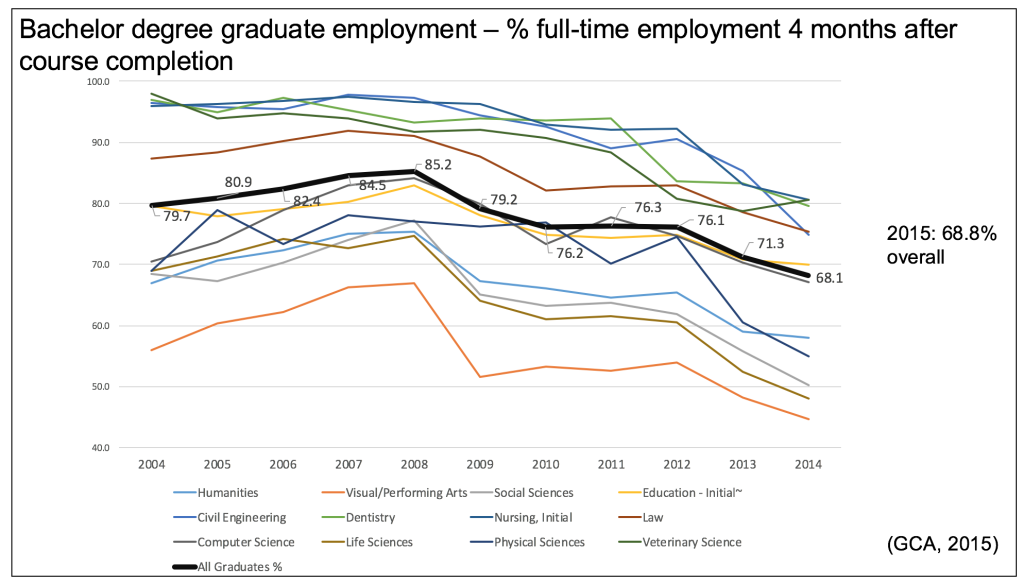
Recently, Australian universities have become highly concerned about graduate employability, and how to ensure that our graduates have positive career outcomes. It’s not that we didn’t care about this before — but recent graduate outcome statistics show that that chances of students gaining full-time employment after graduation are declining in all disciplines, and have been for a few years now. University education represents a signficant investment for students, both in terms of time and effort and course fees, and increasingly want to know that there will be a job for them at the end.

The chief metric that the higher education sector uses to demonstrate positive outcomes is full-time employment 4 months post course completion. This metric comes from graduate surveys known as the Graduate Destintation Surveys (GDS), until recently administered by Graduate Careers Australia.

screen-shot-2016-11-19-at-4-45-43-pm

Under the new QILT (Quality Indicators in Learning and Teaching) system, there are a range of other indicators as well — including a survey of graduate employers asking about graduate employees’ capabilities. There is also a ‘3-year out’ survey of graduate outcomes. The QILT website allows people to compare courses and universities using these indicators. However, the chief metric that is reported and used is still the short-term full-time employment metric, along with median graduate salary.

The short-term full-time employment metric can be useful as an indicator in some respects. For instance, Tom Karmel of the National Institute of Labour Studies, has recently used the GDS to show that more than 50% of the variance in declining graduate outcomes is due to a softening labour market and an oversupply of graduates, particularly in some fields. This has been exacerbated by the introduction of the ‘demand driven system’, and uncapping the number of university places that can be offered in Australia*. The sector is on track to meet its 40% university participation by 2020 target.

Another example of an interesting use of the graduate destination full-time employment metric comes from Denise Jackson from Edith Cowan University, who demonstrated the importance of social capital to initial graduate outcomes, also using statistical modelling of the GDS survey data (in her 2014 study, there was a 54% increase in the chances of full-time job attainment if social network strategies were used).

However, the full-time employment metric we use is problematic in important ways. I summarise these issues as: (i) full-time employment as an employee, (ii) employment is different from employability; and (iii) short-term, narrow outcomes.

1. Full-time employment as an employee. The metric has long been criticised by educators in the arts and creative industries, where the portfolio career (multiple job-holding, self-employment) is ubiquitous – as, of course, is underemployment. But in fields where self-employment and multiple job-holding are common, the ‘full-time employment as an employee’ metric does seem less relevant**. It also might be less relevant across the board in coming years as the traditional organisational career continues to decline, and more and more people are engaged in self-managed, portfolio careers. There is evidence that this is occurring already: while Australia’s overall unemployment rate is steady, the rate of part-time and short-term work overall, and casual jobs for young people 18-24, is increasing. Eighty-six per cent of the new jobs created in Australia last year were part-time. Across OECD nations, 20% of all jobs terminate within one year, and 33% terminate within 3 years. In the US, 40% of work is contingent.

There are also the phenomena of ‘uberisation’ of work, and the start-up economy. While self-employment is actually declining across Australia (according to ABS statistics), more and more people are engaged in informal, self-generated and distributed models of work and income earning through platforms such as Uber, Airtasker (Upwork in the US), and AirBnB. There is also much talk and policy about fostering a start-up economy, particularly in STEM fields, as a way to promote economic growth and social well-being in Australia. It seems that historically, an entrepreneurial career path has not often been chosen by recent graduates, and entrepreneurship is something that tends to be adopted with greater career experience – but it is something that is increasingly being encouraged.

My overall point is this: The national graduate outcomes data collection is the only one we have. If the survey doesn’t include measures of more complex job and career arrangements, we have no way of knowing exactly what’s going on for graduates across Australia. For disciplines where full-time employment is less relevant, and as full-time employment as an employee becomes less common across the economy, it seems less and less useful as a way of describing the outcomes of recent grads.

But of course the GDS (now the GOS in QILT) isn’t just used to describe outcomes — it’s used to benchmark universities and courses against one another. This brings me to my next reservation: employment is very different from employability.

2. Employment is different from employability.

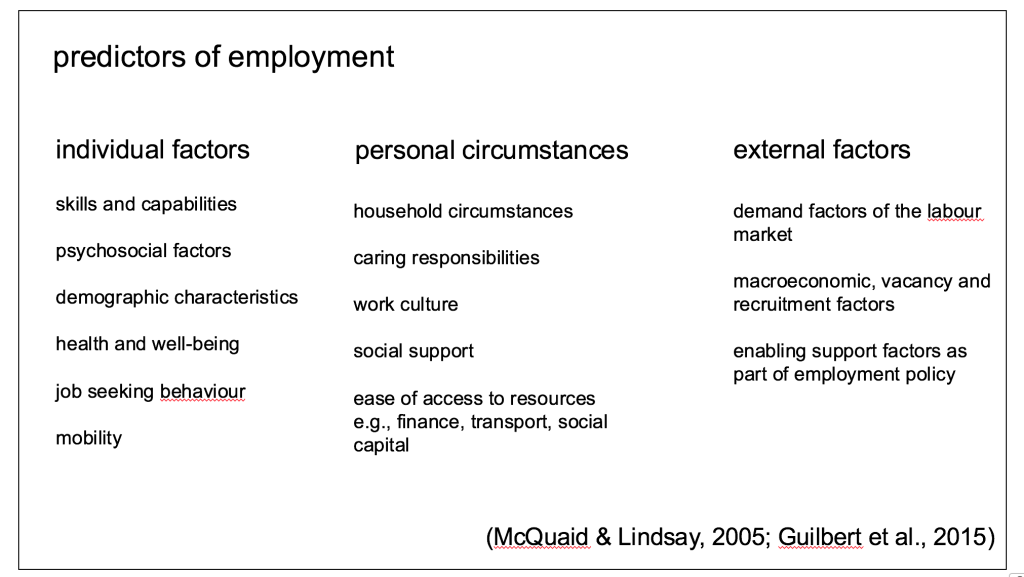
In the last few years, graphs of our declining graduate outcomes like the one above have been used to argue that universities need to be doing more to enhance our students’ employability. However, there are actually a wide range of stronger influences on whether a graduate is employed or not, including (as Tom Karmel points out) the degree of competition for entry-level jobs, and the availability of roles. In 2005, McQuaid and Lindsay published a theoretical framework – one of many – of influences on employability and employment, which they summarise as ‘individual factors’, ‘personal factors’, and ‘external factors’. The traditional remit of universities has been just one element of these: skills and capabilities, and perhaps also some psycho-social factors that can be learned, such as confidence, proactiveness and resilience.

screen-shot-2016-11-20-at-10-09-52-am

I’d argue that there are indeed things universities can do, and can do better, to enhance their students’ employability (and also, while we’re at it, their citizenship and sustainability capabilities). But using graduate outcomes as the benchmark is leading universities to do things that are outside the traditional capability remit, in seeking to compete for one another for students — such as direct interventions around graduate recruitment, and changing the range and types of courses that they deliver to choose those with better short-term full-time employment outcomes. Universities with regional campuses in areas where there is higher unemployment are at a disadvantage in the benchmarking– and I would hate to see them move out of regions and stop offering degrees to people from diverse backgrounds because the graduate employment outcomes might be lower in these regions.

3. Short term, narrow outcomes.

In a context where our KPI is short-term, full-time employment outcomes, universities are more and more ‘teaching to the test’ — which means we are paying close attention to employer surveys where desired graduate employabiliy skills are listed out (interpersonal skills, written communication etc), and we are paying close attention to the skills that professional accrediting and registering bodies say that they need. The idea is to make graduates as ‘oven ready’ as they can be – both in terms of specific technical and disciplinary skills for their professions, and their transferable / generic skills.

One problem here is that the world of work is in massive flux. In teaching to specific outcomes, the danger is that we start encouraging narrow, inflexible career identities, and overly specific, short-term skills. When students graduate in 3 or 4 years’ time, there may not be the demand for (for instance) print journalists, primary school teachers, or graphic designers, and we need our grads to be able to reinvent themselves and their skills to find and obtain other meaningful work. We don’t teach enough for disciplinary and professional agility.

The CEDA (2015) study into the automation of Australian work suggests that over the next decade, more than 40% of existing job roles will disappear anyway (goodbye taxi drivers and telemarketers!). Other entirely new roles will be created — and while it’s difficult to predict exactly what these roles will be, we’re seeing this already in statistics coming from the US around new jobs in information security, big data analytics, and social media. Further, the roles that will remain are changing, and will require different skill sets. Work roles will require more digital capabilities, emotional intelligence, creativity and complex problem solving, and complex manual dexterity (these kinds of skills are less likely to be automatable).

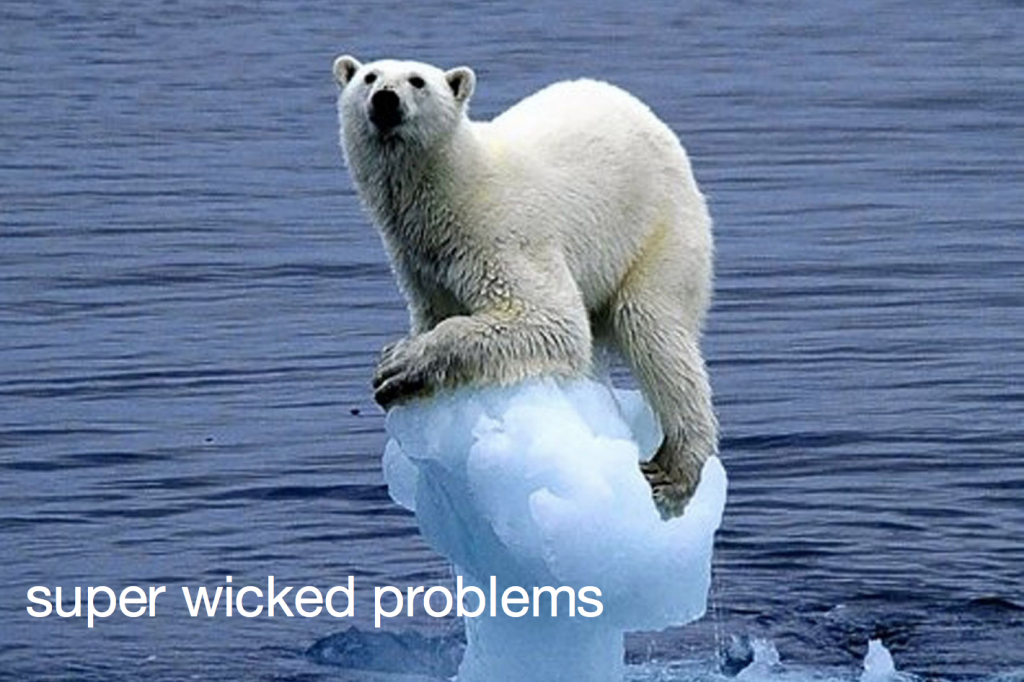
I also suggest that in this age of uncertainty and unprecedented social change and complexity, where we are confronted by more and more ‘super wicked problems’ — climate change, loss of biodiversity, antibiotic resistance, refugees and asylum seekers, widening gaps between the rich and the poor… and the list goes on — surely we need KPIs around capability development beyond employability skills. I read yet another article this morning about global catastrophic risk (nice reading to go with one’s cornflakes) that predicts our chances of destroying ourselves during the 21st century at about 50%. It’s hard to give exact probabilities on these kinds of things. However, the people who are graduating from our universities will lead our world in the coming decades — they need the capabilities to engage with and manage complex social, cultural, economic, and environmental challenges, as well as to find or create work and perform well in that work.

super wicked problem polar bear
Photograph: Carla Lombardo Ehrlich/WWF


So, what should we be measuring?

Measurement and benchmarking is an inevitability in this space. It’s difficult to generate suitable, simple benchmarks for our graduate outcomes. I understand why full-time employment is used – it’s simple, and a good indicator of some things. However, we certainly need more nuanced, longer term outcome measures around employment, that embrace self-employment and the portfolio career as well as the metric of ‘short-term full-time work as an employee’.

We need to provide indicators around the actual capabilities that our graduates possess, and their behaviour (such as setting up their own enterprises, if that’s what we want). These indicators need to include capabilities beyond short-term employability skills, to encompass broader employment outcomes and the changing world of work. Finally, I think we need to include social, cultural, and environmental capability indicators, and those of critical thinking and learning, as well as employability skills.

In turn, we need the infrastructural, HR and policy supports in place so that our graduates are able to make the most of their capabilities. We need a labour market that can accommodate our skilled young people, and where they can make meaningful contributions.

——————————-

*the solution doesn’t seem to be to re-cap the number of places offered. In fact, Andrew Norton offers some interesting commentary about how limiting the number of places in courses actually results in worse labour market mismtaches than we have at present. He provides the example of the 1990s Government restrictive caps on medical student places, and points out that this resulted in widespread shortages of doctors, something that was eventualy mitigated by inviting many more overseas-qualified doctors to practice in Australia.

** I should note here that the graduate outcomes survey does include a measure of ‘part-time employment – seeking full-time employment’ — but it isn’t detailed enough to describe employment patterns.

Save

Save

Save

Save

Save

Save

Save

Save

Save

Save

Save

Save

Save

Save

Save

Save

Save

Save

Save

Save

Save

Save

Save

Save

SaveFacebooktwitterredditpinterestlinkedinmail