Future and change capability in higher education: A midpoint reflection

From individual capability to institutional adaptability

This post marks the halfway point in my series on future and change capability in higher education. Rather than introducing a new component of the framework, I offer a brief sensemaking reflection on where this work has come from and why it matters now.

The beginning of this post is for any readers who might have known me and my work for a while and could be thinking, ‘Ruth Bridgstock’s work is about graduate employability, WIL and careers. Why is she writing about institutional change all of a sudden?’

There is logic to it, I promise, and a trajectory of thoughts and practice over a couple of decades.

My interest in future and change capability did begin with individuals, and graduate employability in a certain sense, and since then it has been helpful to align much of my work with employability policy and discourse, although my interests are deeper and broader.

My doctoral research examined how creative practitioners and graduates develop the capacity to navigate uncertain career paths across the lifespan. I was interested in how people manage learning, identity and professional direction in conditions of ambiguity and change. Over time, that inquiry expanded into questions about how individuals learn to lead and navigate innovation and transformation, as individuals and collaboratively.

My interests shifted into curriculum and pedagogy. I moved out of a research intensive career track and became a teaching-and-research academic, to explore whether I could teach the capabilities I was researching. I wanted to know: How might we design educational experiences that cultivate future and change capability in students? What do educators need in order to support, enable, and facilitate? Eventually, as I moved into institutional leadership roles, these questions led to deeper and more challenging ones.

What became apparent was that educational innovation was often being undermined by institutional structures not designed for learning or adaptation. I started to ask: if we truly want students and educators to be adaptable and capable, what must our educational institutions be and do? Significant change was clearly needed.

That progression – from individual capability to educator practice to institutional systems and architecture – has unfolded for me across research, academic leadership and large-scale educational transformation over the last 20 years. After two decades of exploration and experimentation, I have come to the conclusion that without an adaptable HE system with adaptable institutions within it, we cannot effectively enable educators and students to be future and change capable – and future and change capability is vital to our futures.

I no longer believe that future and change capability can be meaningfully developed at the level of the individual student without being actively constrained or enabled by educator practices and capability, and the institutional context.

My timing isn’t incidental. As I argued in post 1, artificial intelligence, funding volatility, workforce transformation, social change and policy reform have intensified the demand for adaptive capability in students and graduates, and at every level of higher education. What began as a question framed in terms of graduate employability has become a broader question about higher education’s sustainability, public value and long-term contribution.

The framework I present in this series integrates several strands: identity and differentiation; permeability and institutional learning; strategy, governance and risk; culture and capability; and engagement with external forces. Together, they outline a model of the future and change capable university.

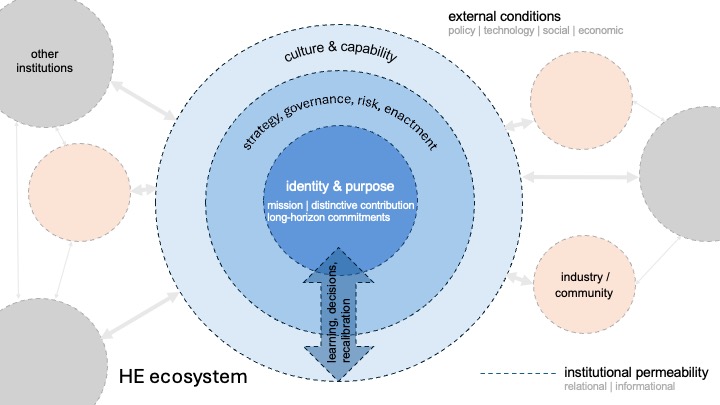
The model below synthesises the elements developed across this series into an integrated framework for institutional adaptability.

The future and change capable university.

Identity and purpose sit at the core of the institution, anchoring distinctive contribution and long-horizon commitment (post 2). Around that core, strategy, governance, risk and enactment shape how choices are made, sustained and adjusted. Institutional permeability describes how boundaries are intentionally designed: how relationships, information and practice move across academic, organisational and sectoral domains (post 3). Permeability expands what the institution can see; decision architecture determines how insight is translated into action. Learning and recalibration connect experience, evidence and judgement over time. Culture and capability permeate the whole, enabling disciplined interpretation and collective decision-making.

The university operates within a broader ecosystem of policy, professions, technology, industry and community. These conditions cannot be controlled, but they can be engaged with deliberately. Future and change capability develops cumulatively through the alignment of identity, permeability and strategic judgement.

Here I am synthesising and building upon various streams of theoretical work — key contributions that come to mind are Senge’s learning organisations, the double-loop learning of Argyris & Schon, complex adaptive systems, learning ecosystems, innovation systems and triple helix models, and strategic management theory such as Mintzberg & Teece. I’m integrating and extending these for higher education by placing identity, public accountability, and decision architecture at the centre. This is a deliberate departure from capability framings that privilege responsiveness alone; in higher education, adaptability without identity quickly becomes incoherence. Adaptability becomes the cumulative outcome of aligned purpose, selective permeability, disciplined experimentation and governance under constraint.

Three posts in this series remain. They will examine decision architecture and processes in greater depth, explore how culture and capability enable decision-making under uncertainty, and consider how institutions can engage with shifting external conditions without losing coherence.

This model offers an emergent framework for thinking about purposeful institutional adaptability in contemporary higher education.

I invite critique, refinement and collaboration from colleagues who are exploring similar challenges. If the model is useful, I will translate its elements into practical tools to support institutional analysis, disciplined choice and sustained change.

Facebooktwitterredditpinterestlinkedinmail

Adaptive Ecosystems: Designing University Permeability for Future and Change Capability in Higher Education

This article is the 3rd in a series about making universities more future and change capable. Article 1 is here, and article 2 is here.

In previous posts, I argued that universities’ core challenge in navigating change is not resistance, but a lack of future and change capability: the institutional capacity to decide, deliberately and proportionately, when to change and when to hold steady, and to act coherently and sustain those choices over time.

Clarity of identity is foundational to future and change capability. But identity alone is insufficient. Universities must also consider how they are structurally connected to the environments in which they operate, and how those connections shape learning, judgement and action.

Universities operate within dense networks of policy settings, industries, professions, communities, technologies and social expectations. These relationships shape what institutions see, what they learn and what they are able to do. Adaptability requires institutional receptiveness to signals from their networks, particularly when those signals challenge established priorities or sunk investments.

All universities are embedded in ecosystems. The question for me is whether, and if so how, they have deliberately designed their institutional permeability within those ecosystems.

In this article, ecosystem refers to the broader network of relationships within which universities operate. Permeability describes how institutional boundaries are designed so that information, practice and collaboration move across them.

The term ecosystem requires care. Universities are not organic systems whose adaptation unfolds naturally through ecological interaction. They are public institutions with defined responsibilities and accountability obligations. Their adaptability depends on how deliberately they shape the boundaries through which they engage with others.

Universities generate knowledge, data and practice internally that must circulate effectively across academic and administrative domains. Boundaries determine how insight moves in both directions: how developments beyond the institution are taken up, and how internal expertise, research and experience inform strategy and external engagement. When those pathways are intentionally structured, information does not simply accumulate; it travels to places where it can inform deliberation and action.

This deliberate shaping of boundaries is what I mean by permeability, and it is what allows institutions to learn cumulatively rather than episodically. It refers to the intentional design of channels through which ideas, evidence and practice move across institutional domains and between the university and the wider ecosystem.

The following features illustrate how adaptive institutions design permeability in practice. The features are: relational infrastructure, shared expertise and co-design, structured experimentation, and informational permeability.

Relational Infrastructure

Relational infrastructure is one of the clearest expressions of institutional permeability. Most universities already possess substantial relational capacity, though often in uneven and fragmented forms.

Relationships exist across faculties, research centres, advancement teams, marketing functions and alumni networks. Advisory boards are convened, collaborations are formed and partnerships are announced. Yet these relationships frequently develop in parallel rather than in concert. They reflect local priorities, short-term projects or immediate resource needs.

Universities do not consistently treat relational infrastructure as an institutional capability in its own right. Where investment occurs, it is often directed toward short-term outcomes in recruitment, teaching, reputation or philanthropy. These functions are important, but relationships also represent deeper relational capital: accumulated trust, insight and shared experience that can inform institutional direction over time. That capital is not always recognised or mobilised as such.

Fragmentation is common in universities. Partnerships are distributed across organisational silos, information flows are incomplete and brokerage roles are inconsistently embedded in academic and strategic processes. Customer relationship management systems may exist, yet insight does not necessarily circulate beyond the units that generate it. Relational capital remains localised rather than institutional.

Permeability requires a more deliberate approach. It involves cultivating multi-stranded relationships that extend across research, teaching, innovation and engagement. It requires brokerage capacity that connects boundary work to strategic and academic processes. It depends on reciprocity: partnerships sustained through shared purpose and mutual benefit rather than transactional exchange.

Selectivity is equally important. Institutions cannot engage everywhere. The choice of relationships — which sectors, professions, communities and collaborators are prioritised — should align with institutional identity and long-term direction.

Where relational infrastructure is embedded in this way, it influences how the university defines problems, allocates resources and adapts over time. Relational capital becomes consequential when it shapes institutional trajectory rather than remaining an untapped asset.

Shared Expertise and Co-Design

Widespread co-design across an institution is another marker of permeability. It signals that boundaries are sufficiently open — internally and externally — for knowledge to be shaped collaboratively rather than transmitted in one direction.

Adaptability depends not only on access to information, but on how problems are framed and interpreted. Shared design processes influence that framing. When industry partners, community organisations, students and colleagues across faculties contribute to curriculum architecture, research priorities or program review, they reshape the questions being asked as well as the answers being generated. Misalignments between institutional assumptions and lived practice become more visible; constraints and opportunities surface earlier.

The value of co-design lies partly in epistemic expansion. Broadening participation reshapes how evidence is weighed and how institutional judgements are formed. It can narrow the distance between strategy and implementation, between professional practice and academic design, and between central priorities and local realities.

Participation in co-design relies on reciprocity. Contributors engage when they can see that their involvement will matter. For some partners, this may mean access to emerging talent or influence over curriculum direction; for others, it reflects professional stewardship or shared commitment to public purpose. Students may require payment for their time and expertise. Where outcomes are opaque or contributions have little visible effect, engagement weakens.

Not every institutional decision warrants co-design or collaborative shaping. The appropriateness of co-design depends on the object of design and what is at stake. Issues that depend on diverse expertise or shared ownership lend themselves to participatory processes. Others require timely executive judgement within established authority structures.

Structural tensions are unavoidable. Deliberative processes require time and coordination. Power asymmetries can distort participation. Conflicting stakeholder values may surface. Internal co-design — across faculties, central units and leadership — is often as significant as external collaboration. Without alignment across institutional domains, external insight struggles to gain traction.

Shared expertise strengthens institutional adaptability when participation is embedded within processes that connect contribution to institutional purpose.

Structured Experimentation

Adaptive and permeable institutions require structured experimentation: deliberate, bounded forms of variation through which new practices, configurations and partnerships can be tested before wider adoption.

Structured experimentation introduces controlled uncertainty into institutional practice.
Doing this well is demanding: it asks institutions to create space for learning in environments already stretched by workload, compliance and delivery pressures. It creates defined environments in which curriculum models, research translation pathways, partnership structures or organisational arrangements can be trialled at manageable scale. These environments are time-bound and linked to evaluation so that experimentation generates knowledge rather than simply activity.

Many universities already contain elements of this architecture. Curriculum sandpits allow academic teams to prototype new program designs. Applied research laboratories and translational hubs connect scholarly inquiry with partner practice. Incubator and accelerator programs support industry, student and staff enterprise while exposing institutional processes to emerging forms of work. Co-location within innovation precincts brings together researchers, educators, start-ups, established firms and community organisations in shared physical or virtual spaces. When intentionally designed, such precincts connect teaching, research and applied activity, enabling joint problem-solving and iterative development rather than episodic engagement.

These arrangements can be valuable because they make institutional variation visible and discussable. By clarifying what is being attempted, over what period and with what forms of evidence, institutions create conditions for informed judgement. Adaptation often depends on translating structured inquiry into practice.

Structured experimentation also helps manage tempo. Co-design and academic deliberation take time; external developments often move more quickly. Time-bound trials allow provisional responses while evidence accumulates. Institutions can adjust without committing prematurely to wholesale reform.

Interpretation of experiments remains centrally important. Evidence generated through trials must move into spaces where it can be weighed against mission, capacity and long-term direction. Where trials conclude without reflection, promising work dissipates. Where initiatives persist without clear evaluation, portfolios thicken without becoming stronger. Adaptive capacity depends on treating experimentation as part of institutional learning rather than as isolated activity.

When connected to relational infrastructure and aligned with institutional direction, structured experimentation strengthens permeability. It enables institutions to respond to change in ways that are deliberate, proportionate and cumulative.

Informational Permeability

Permeability expands what a university can see. Informational permeability determines whether that visibility sharpens judgement.

Adaptive institutions treat data, evidence and external intelligence as strategic resources. Insight takes multiple forms: institutional data about participation and performance; evaluative evidence from programs and experiments; sector-wide intelligence on labour markets, technology and policy; and knowledge generated through research and professional engagement. Most universities possess these forms of insight in some measure. Fewer integrate them deliberately.

Informational permeability rests on four interrelated practices.

Access. Relevant data and intelligence need to be accessible to those making consequential decisions. Fragmented systems, uneven analytical capability and restricted ownership limit awareness. Foundational data infrastructure and analytical expertise matter here, as does systematic engagement with external intelligence — labour market analytics, professional standards, technological developments and global higher education trends — rather than reliance on informal networks.

Interpretation. Insight requires collective sense-making. Patterns in student progression, research performance, demographic change, partnership outcomes or industry demand require contextual reading. Interpretation depends on forums in which evidence is examined in light of institutional purpose and capacity.

Translation. Information must be converted into practical implications. Labour market analysis may inform portfolio decisions; research capability mapping may shape partnership strategy; demographic shifts may alter recruitment and support models; technological developments may prompt redesign of services or investment priorities.

Use. Insight acquires institutional value when it influences decisions over time. This includes evaluating initiatives against explicit aims, discontinuing activity where outcomes are weak, consolidating where impact is demonstrable and adjusting where conditions shift. It also requires distribution: ensuring that relevant parts of the institution engage with and apply insight appropriately.

Together, these practices determine whether information shapes decisions about what to invest in, what to stop and what to reshape, or simply sits alongside them.

Arizona State University provides a useful illustration of informational permeability. Its investment in integrated student data systems linking progression analytics, curriculum design and support services has strengthened institutional responsiveness. The significance lies not only in technology, but in the alignment between information flows and institutional priorities. Insight informs redesign; redesign generates further insight; learning accumulates.

When data and intelligence remain fragmented, institutions respond in fragments.
In practice, institutions vary in how willing they are to confront what such insights reveal, particularly when it challenges established priorities or sunk investments.
When informational permeability is designed deliberately, insight travels, accumulates and sharpens adaptive capacity.

Conclusion: From Permeability to Capability

Adaptive capacity depends on the alignment between identity and permeability. Clarity of purpose anchors direction; permeability expands awareness. Together they shape the conditions under which institutions can learn deliberately rather than react episodically.

Relational infrastructure, shared expertise, structured experimentation and informational permeability broaden what institutions can see, test and understand. They create channels through which insight enters and circulates. Awareness alone does not constitute capability. Institutions must also be prepared to engage seriously with what that insight reveals, particularly when it challenges established priorities or settled assumptions.

The implications extend beyond individual institutions. A differentiated system strengthens permeability when institutions cultivate relationships and informational practices aligned with their distinctive missions. Policy settings are therefore important. When regulatory and funding frameworks assume uniform portfolios, relational and informational designs converge. When they enable differentiated contribution, permeability can deepen rather than fragment.

Many institutions can sense what is changing around them. Far fewer have deliberately designed the pathways that allow insight to accumulate, and the resolve to act on it thoughtfully.

The next article turns to how universities can design processes that translate institutional learning into deliberate, proportionate action over time.

Facebooktwitterredditpinterestlinkedinmail

AI adoption and the reshaping of early-career capability – a shared challenge for higher education and industry

Last week I delivered the opening keynote at the Graduate Employability: Insights to Impact Forum hosted by Swinburne on how generative and agentic AI are reshaping early-career work, and how industry, universities and students can be better prepared for it. I’ve had a few days to reflect, and I’m ready to share some thoughts.

The dominant media-driven narratives remain polarised. Either AI will eliminate graduate jobs (“the graduate jobpocalypse!”, “a robot stole my internship!”), or the AI bubble will burst, forcing a dramatic correction, a decline in organisational use, and the re-hiring of all the graduates we replaced with robots.

Clear-eyed analysis of evidence emerging from my employer survey research in Australia, international workforce analyses out of Stanford and Harvard, and recent graduate outcomes data suggests a far more complex picture — one that requires a nuanced and collaborative response.

In the United States, entry-level roles in many professional areas are in decline, partly attributable to AI adoption. In Australia, we can see the beginning of possible declines in graduate opportunities in bellwether disciplines like IT and law. However, my research with Australian employers suggests AI adoption is uneven. Its impact varies by sector, regulatory context, organisational size, leadership preference and task profile. Across these differences, however, some structural shifts are becoming clearer.

Routine, programmable tasks are declining. Expectations around judgement, oversight, integration and complex human interaction are rising — often far earlier in career trajectories than before. Entry-level roles are becoming broader, more cognitively demanding and less scaffolded. For instance, entry-level supply chain and logistics professionals are being asked to problem-solve anomalies and exceptions rather than beginning their careers with foundational data updating, reporting and compliance tracking.

Entry-level workforce shifts are happening, but I’m not seeing a jobpocalypse.

Many of us will have heard stories of organisations keen to take advantage of perceived AI efficiencies, moving quickly to adopt AI and reducing graduate hiring. Now, with greater AI maturity and clearer insights into organisational capability, public reporting suggests IBM and others are making more room for entry-level roles again.

For decades, many organisations have relied on pyramid-shaped workforce models, where early-career roles were places to perform straightforward tasks and also provided protected space in which tacit knowledge and professional judgement could be formed. When AI is introduced primarily as a tool for automation, without redesigning those developmental pathways, capability formation becomes compressed. We begin to see the emergence of more “diamond-shaped” structures, with fewer entry points and heavier reliance on mid-career expertise.

This approach may improve short-term efficiency (though, as I’ll share below, mounting evidence suggests otherwise). It certainly does not support long-term capability sustainability, and many organisations are now recognising this.

A very recent workflow study from Stanford examined software development workflows and tasks performed by AI and people. It found that full automation — for example, “write the code for this app” or “write the analytical report for Y” — often introduces significant inefficiencies through human checking and rework at the end. By contrast, where humans retain oversight and use AI to augment defined components of work within a workflow (staying in control and delegating programmable sub-steps such as data cleaning or boilerplate code), productivity gains are much stronger.

The study found that the automation approach resulted in an 18% productivity decline, while the augmentation approach resulted in a 24% productivity increase.

For educators, these findings shift the conversation beyond AI literacy.

Graduates do need technical capability and AI literacy (“how to get AI to do what I need and ensure the output is high quality”). More critically, however, they require AI fluency: the capacity to use AI for augmentation — knowing when to use it and when not to — exercising domain judgement, interrogating outputs, understanding limitations, integrating ethical reasoning, and achieving the best overall outcome possible.

As one industry panellist at the forum observed:

“AI isn’t replacing human judgement. It’s making the absence of judgement more visible.”

The question for universities is how we integrate these fluencies into our courses, even as industry is concurrently working out how best to augment rather than automate with AI — and as AI capability itself continues to advance rapidly. This is a strong signal that we need to move away from legacy, slow-moving “curriculum in boxes” towards more advanced forms of authentic learning and teaching. Further, we need to go beyond episodic industry engagement to deep, reciprocally beneficial partnerships, collaborating to redesign the way professional capability is developed and talent pipelines are formed.

We can’t get away with tinkering at the edges of curriculum. This is a deep design challenge to which higher education and industry need to commit.

Facebooktwitterredditpinterestlinkedinmail

Identity Before Adaptability: Laying the Foundations for Future and Change Capability in Higher Education

In my previous post, I argued that a central challenge facing universities in these times of flux is not resistance to change, but a lack of future and change capability. By this I mean the institutional ability to decide, deliberately and in time, when and what to change and when and what not to, and then to act on those decisions. This second piece considers a foundational condition for building that capability: clarity of purpose and identity.

Australian universities face constant pressure to adapt. Artificial intelligence, funding volatility, policy shifts and changes in student demand all demand response. Many commentators have pointed out that institutions are not built for speed or sustained change, and discussions about why often focus on process, structure, and culture. While these are important factors, I suggest that a key difficulty lies at the level of strategy, or deeper still, at the level of identity. Without a clear sense of purpose in an institution, too many changes appear equally urgent, equally plausible, and equally unavoidable, making coherent choice increasingly difficult.

Identity before adaptability

At the institutional level, future and change capability begins with shared clarity about what an institution exists to do, what it will prioritise, and what it will choose not to pursue as conditions evolve. Technical capability, financial capacity, and a skilled workforce all matter. However, in the absence of a coherent identity, even well-resourced institutions struggle to translate capability into sustained direction.

By identity I mean a clear articulation of purpose and long-term priorities that functions as a decision framework, with strategic and operational consequences. Identity shapes what we stop, what we scale, and how we allocate constrained time, budget, and political capital. It also informs how we respond to external pressure and internal opportunity.

As with individual identity, institutional identity emerges from a combination of self-awareness and contextual awareness. It synthesises understanding of distinctive strengths and values with knowledge of community needs, policy directions, and emerging opportunities. Institutional identities are not slogans or branding exercises. They are made visible through educational offerings, research agendas, engagement practices, and partnerships.

Importantly, institutional identity is primarily horizontal rather than vertical. It is not about tiering institutions by status or performance, but about purpose and mission. Institutions might orient themselves toward online lifelong professional learning; integrated academic and work-based education; modular skills development; deep regional engagement; or missions relating to environmental sustainability, health, or security. These are choices about contribution, not rank.

The future is diverse and fast-changing. It is increasingly clear that a single, resource-constrained institution cannot do everything or respond to everything effectively. Rather than maximising breadth, institutions need to make deliberate choices about a smaller number of priorities and pursue them well. Paradoxically, this selectivity strengthens adaptability by reducing noise and clarifying what matters when change is required.

It should be noted that clarity of identity does not remove short-term pressure. Universities will continue to face urgent demands arising from funding constraints, workforce challenges, and policy shifts. What identity provides is a basis for judgement: deciding which pressures to absorb, which to resist, and which warrant deeper adaptation. Without this shared basis, institutions risk treating all pressures as equally urgent, increasing fragmentation and strategic drift.

Starting with the sector: who are we and what are we for?

Institutional identity does not develop in isolation. Universities operate within systems that both enable and constrain what is possible.

At the sector level, fundamental questions remain unresolved: what does Australian society expect higher education to contribute over the long term? How does the sector understand its collective role in meeting those expectations? How can we design a system capable of responding to increasing complexity in technology, workforce demand, and social need?

Sector-level clarity is important because it shapes how institutions interpret external signals such as funding incentives, regulation, rankings, and reputational cues. Government policy settings play a significant role in shaping what kinds of institutional directions are seen as legitimate, fundable, and sustainable. While these settings inevitably shift with political priorities, they are most effective when underpinned by a shared understanding of what higher education is for and how it operates. In the absence of that foundation, short-term signals dominate and coherence erodes at both system and institutional levels.

Sector-level identity enables institutional positioning. Where it is weak or ambiguous, institutional identity is progressively diluted, and strategies become increasingly reactive.

The cost of trying to be everything

In many respects, Australian universities are strikingly similar. Many pursue growth in the same markets, compete for the same student cohorts, and seek recognition through the same measures of success. The result is duplication, dispersed capability, and rising internal complexity.

In some ways, duplication and breadth of activity are not problematic. In complex systems, some redundancy and slack can support experimentation, learning, and innovation. Difficulties arise when breadth reflects accumulated activity rather than deliberate choice, and when few activities are ever stopped. Under these conditions, inefficiency becomes structural rather than strategic. Cautious expansion happens across many fronts. Institutions grow widely rather than deeply, diluting focus and making it harder to sustain excellence or adapt coherently.

There are, however, signs of alternative approaches within the Australian system. Some institutions have begun aligning strategy around a smaller number of distinctive commitments, such as focused research concentrations, deep regional engagement, or industry-embedded education. Smaller providers often operate with clearer specialisation, orienting programs and partnerships around specific missions.

In these cases, identity starts to function as a lived decision framework rather than an abstract statement. Choices about investment, partnership, growth, and withdrawal are made with reference to mission rather than opportunity alone. This provides clearer signals to staff, students, and partners about what the institution is for and how success should be understood.

Such approaches involve trade-offs. They may require declining opportunities, narrowing scope, or resisting sector-wide trends. Yet they can also reduce internal friction, strengthen coherence across teaching, research, and engagement, and support more confident long-term investment. Where clarity is present, institutions are better positioned to adapt without repeatedly resetting direction.

Time horizons, strategic lurches, leadership, and trust

Institutional identity work unfolds over much longer horizons than those that typically govern university decision making. Three-year government terms, five-year strategic plans, executive contracts, and council appointments create short cycles of attention and accountability. In the absence of an enduring sense of purpose, these cycles can produce not strategic drift but strategic lurching: repeated shifts in direction as institutions respond to successive policy signals, leadership preferences, or funding pressures.

A coherent institutional identity evolves over time but provides continuity across these transitions. It enables institutions to adjust course without repeatedly redefining purpose, supporting cumulative rather than episodic strategy.

Clarity and continuity of identity are closely linked to trust. When priorities are diffuse or frequently changing, staff learn that effort invested in one direction may be under-supported or reversed. For students and partners, instability makes informed choices more difficult. For governments and communities, unclear identity weakens confidence that public investment aligns with public purpose.

Trust is built through consistency of intent. Adaptation is more likely to be supported when guided by stable institutional commitments. Identity functions as a durable reference point: core commitments remain relatively enduring, while their expression develops through evidence, experimentation, and learning. Identity work is therefore an ongoing institutional practice rather than a one-off strategic exercise.

Differentiation and the Australian policy context

A sector composed of institutions with clear, consistent, and complementary identities is a differentiated system. While differentiation is widely endorsed in principle, it is weakly supported by current Australian policy settings. Funding, regulatory, and accountability frameworks largely assume institutional homogeneity, while rankings reinforce convergence by rewarding comprehensive activity across a narrow set of indicators. Together, these dynamics encourage institutions to look alike and compete on similar terms.

The Australian Universities Accord has reopened important questions about sector purpose and coherence. One opportunity lies in moving beyond uniform expectations toward a more differentiated ecosystem. Mission-based or bespoke institutional compacts are often proposed as a mechanism for achieving this.

Mission-based funding has been widely criticised in Australia, and not without reason. In theory, such compacts align funding and accountability with clearly articulated missions rather than generic performance metrics. In practice, they have often drifted toward compliance or micromanagement, limiting their capacity to genuinely support differentiation.

International experience suggests that more effective approaches focus on a small number of long-horizon outcomes, include independent review, allocate meaningful funding to missions, and operate on stable review cycles. Differentiation can sit above a shared baseline of agreed principles around quality, equity, and regional provision. Specialisation at institutional level need not reduce student choice at system level when supported by credit portability, shared curricula, and cross-institution enrolment mechanisms. Rankings will continue to shape reputation, but institutions can rebalance internal success measures toward mission outcomes to reduce disproportionate strategic responses to marginal rank movements.

Historically, Australian higher education policy has prioritised comparability, growth, and comprehensiveness. While these settings have supported expansion and stability, they also make it difficult for institutions to pursue distinctive long-term missions with confidence or to adapt in conditions of ongoing complexity.

The work of institutional identity development

Institutional identity development is difficult work. It requires confronting legacy assumptions about breadth and growth, undertaking honest assessment of strengths and constraints, and making decisions that may be unpopular. Sustaining identity over time requires leadership and governance arrangements that treat purpose as enduring institutional work rather than branding or a static element of a strategic plan.

From identity to capability

A more future and change capable higher education system will not be achieved by expecting every institution to do everything, nor by relying on short cycles of reform or performance pressure alone. It requires institutions with clear, enduring identities that guide coherent choices over time, and a policy environment that enables difference without fragmenting the system as a whole.

When institutional purpose is stable, adaptation becomes more deliberate, trust more likely, and collaboration more feasible. Differentiation, understood not as hierarchy but as complementarity, allows institutions to contribute in distinct ways while collectively meeting public needs. In this sense, identity is not a constraint on adaptability but its precondition, providing a stable basis for judgement as universities navigate uncertainty, leadership change, and shifting societal expectations.

The next piece in this series turns to how clarity of identity can be translated into action and adaptability.

Facebooktwitterredditpinterestlinkedinmail

In these disruptive times, universities don’t need to be less resistant to change.

They do need a more advanced kind of capability for change.

As we embark on another working year, I’ve been reflecting on the challenges and opportunities facing universities in 2026. And yes, me being me it’s turned into a 1,700 word theory of change piece… there is also a conceptual model, and I have some practical ideas about implementation, which I’ll save to share later if they’re useful. But here’s the introductory piece.

Universities: facing disruptive change and increasing pressure to change
The higher education sector is now thoroughly familiar with the ‘universities are facing disruptive change’ narrative. Today, that narrative is most often associated with the sudden ubiquity of generative AI; before that, it was the pandemic. The underlying concern, however, remains the same: the business sustainability of universities. Other pressures in Australian higher education include policy-led financial constraints and shifting funding models, and intensifying institutional competition from within the sector and elsewhere. Taken together, these pressures don’t just strain university finances. They shape institutional decision-making, risk tolerance, and the kinds of educational trade-offs universities feel compelled to make.

This disruption narrative is often conflated with a related but distinct one: that higher education itself needs to change. This second narrative points to growing mismatches between what universities do and offer and what their stakeholders expect. In 2025, the decline in social license and erosion of public confidence and trust were key issues for the sector, driven by perceptions that universities have become overly corporatised and out of touch with community concerns. Some of the criticisms relate to universities’ difficulties keeping up with an increasingly diverse student population, meeting evolving learning needs, and catering to rapidly changing workforce skill requirements.

How can our students be more adaptable if we aren’t?
Across roles and initiatives that I’ve pursued in my career, there is a recurrent theme: leading and enabling change within institutions, with the overall aim of supporting learners to become more future- and change-capable. For instance, at my current institution I’ve worked with educators to embed work-integrated learning at every level of every undergraduate course; I’ve infused career development learning into the curriculum with positive impact on student engagement, retention, success and graduate outcomes; and most recently, I’ve been using data to personalise learning and student support within and beyond the curriculum.

Much of this work has involved connecting parts of the institution that do not naturally collaborate, partnering with industry, community, educators, and learners themselves, and working across entrenched silos and legacy processes in pursuit of transformation. Across these initiatives, the common challenge has been less about persuading individuals to change (although stakeholder engagement has been centrally important), and more about enabling universities to act coherently and responsively. Within universities we’ve all had innumerable ‘process wagging the dog’, ‘computer says no’, ‘ivory tower syndrome’ and ‘fiefdom mentality’ experiences that militate against change.

At a higher level, what I have noticed through my experiences is that to develop future-and-change capable learners and graduates who will be successful in their lives and careers, you need future-and-change capable educators, and in turn future-and-change capable institutions (and a policy context that enables all of the above). Put another way, it is very difficult to teach students to be proactive and adaptable when their educational experiences, programs, processes, structures and environments they encounter are reactive and rigid.

Change resistance: Not the enemy, necessarily
Universities are often described as change-resistant, and this is usually framed as a criticism. Actually, and this may seem to run counter to what I’ve just said – bear with me – I think that some change resistance in higher education can be a good thing.
Commitments to educational quality, consistency, and accountability are essential. Quality assurance requirements play a legitimate and necessary role in maintaining trust in higher education. Too much change leads to exhaustion and confusion.

Here’s where the nuance comes in. I’d argue that universities need to build our capability to know when (and how) to flex, and when (and how) not to. In many ways, we’ve erred on the side of non-change for a long time. Over time, layers of bureaucracy and administrivia have accumulated – often in response to past risks or policy pressures – without being revisited or tested against their ongoing value. I suggest that some of these structures are no longer proportionate to the quality aims they were designed to serve, yet they continue to shape what is possible, how quickly institutions can move, and where effort is expended. A good example here is course development and accreditation processes, which can sometimes be so glacially slow that once finally approved, a new course immediately needs to be redesigned to be relevant.

There is an important difference here between principled resistance, grounded in educational quality, equity, and accountability, and inertial resistance that persists simply because systems are difficult to change. In this sense, selective resistance is not a liability but a contributor to public trust and social licence, signalling that universities do not abandon core values in the face of every new pressure.

The deeper problem isn’t resistance to change, but that universities are not sufficiently future-and-change capable. Future-and-change capability is a distinct institutional capability, infused into all of our core activities at every level of the institution, that shapes how universities navigate uncertainty over time.

This isn’t another call for university agility, innovation, or cultural change alone. It is an argument about the fundamentals of institutional design – about embedding adaptive capacity into governance, systems, and everyday decision-making. It is a set of institutional capabilities embedded in structures, processes, and ways of working. A future-and-change capable university can make good, informed decisions with the future and the present in mind at every level of the institution, to change and adapt where needed or stay put when this is the best course of action.


Reactive, sustaining and transformative change
Universities can and do change. However, much change in universities remains reactive and mostly unexamined, triggered by external shocks and requiring extraordinary actions and measures. From the inside, reactive change can feel like a sudden sideways lurch: priorities shift, funding is reallocated, roles and structures are reshaped. The aim of reactive change is not transformation. It is usually about returning to a viable version of the status quo. Over time, this reactive pattern erodes staff trust, depletes morale, and weakens institutional memory, making subsequent change harder rather than easier.

Universities also pursue what might be described as sustaining change: proactive, incremental improvements intended to enhance existing practices, programs, or systems. While these initiatives are frequently well-designed and evidence-informed, they are less often structurally protected. Unlike routine continuous improvement, sustaining change often challenges existing power arrangements, resource allocations, or performance metrics, which can make it more vulnerable. When priorities shift, leaders move on, or funding and policy settings change, sustaining change initiatives can stall or disappear, sometimes irrespective of their impact or value. Often, what is missing is structural protection: stable funding, formal governance ownership, embedded roles, and alignment with core institutional processes.

It seems many of our institutions struggle to do any form of change particularly well. Reactive change is exhausting, disruptive and sometimes frightening for those affected. Sustaining change can be fragile and difficult to maintain over time. Change often seems to be something universities endure, rather than something they are structurally equipped to navigate, learn from, and build upon.


The deeper problem is not that universities resist change, but that they lack the capability to decide – deliberately, proportionately, and in time – when and how to change and when not to, and then to carry those actions through.

There are, of course, institutions that have pursued more substantial transformations successfully, including new models and modes of delivery, large-scale pedagogic change, deeply data-informed approaches to curriculum and student support, short-form credentials, and co-ordinated tertiary offerings across vocational and higher education. What makes these examples compelling is that these are instances where, despite universities’ change resistant and risk averse reputations, they have taken larger risks proactively in pursuit of meaningful change.

Also, we find in many of these innovations evidence that institutions have sought to meet sector policy priorities and business sustainability imperatives concurrently, while keeping core ideas around HE values, identity and purpose at the forefront (which might also, incidentally, help rebuild our social license). Success here takes courage and outstanding leadership, along with the right enabling conditions.

What is future-and-change capability? (AKA I finally get to the point)
But my thinking keeps returning to how higher education institutions (and the sector as a whole) can start to become more future-and-change capable in an ongoing way. Innovation cannot be a one-off project or even a periodic endeavour for universities, as disruptors, change pressures and opportunities continually emerge. Yet for many institutions, there remains a significant gap between acknowledging this need and having the institutional capability required to act on it consistently.

Proactive, conscious, deliberate and ongoing approaches to navigating change must become normalised in higher education. This begins with ensuring that we are continually looking around and ahead, experimenting, and connecting meaningfully with our communities, then interpreting what we are seeing. We need to sense-make actively from these experiences and make informed decisions about how to act that are also grounded in who we are and why we exist.

Universities also need to ensure that we have the capability to act – that we are equipped and ready to transform, adapt, or deliberately hold steady, and that we learn from our actions. This means building feedback loops that allow us to assess outcomes, adjust course, and sustain effective change over time, rather than repeatedly resetting in response to each new pressure.

I know that what I am calling for is a huge challenge for institutions and the sector, given the complexity of our internal and external contexts, and the constraints that we face. I also think it’s central to our survival and our ongoing place in society.

It means supporting students and staff to develop their own adaptive capabilities, while also building enabling adaptive institutional structures and processes. We must also recognise that no institution can do this work in isolation. Connecting and collaborating across boundaries – with other institutions, communities, and policy makers – is essential to building and sustaining an adaptive educational ecosystem. For senior leaders, this means shifting some of their attention from each initiative or transformational program to the harder work of building enduring institutional capabilities that allow universities to adapt with integrity and purpose over time.

If higher education is serious about preparing learners for uncertain futures, then the sector itself must become more future- and change-capable. This will never occur through episodic reform, but by building aligned, adaptive capability and action across learners, educators, institutions, and the systems that shape them.

—-
This piece could be the first in a short series exploring what future-and-change capability could mean for higher education institutions and the sector. As I mentioned up front I have further thoughts about what future-and-change capability involves, what it could look like in practice institutionally and sectorally, and how to surmount the challenges involved in becoming more future-and-change capable.

I’m keen to hear from colleagues about your experiences of institutional change, particularly when it has been effective (or has had effective elements), or where ongoing adaptation has been a feature. Are there examples that you know of from higher education or other highly regulated sectors containing large organisations where continual adaptation is done well? Please get in touch if you’d like.


NB. I wrote this post as a scholar of higher education, without critique of any particular institution or initiative in mind.

AI use and post development disclosure: I wrote a first draft of this post and asked ChatGPT to edit it critically. I reviewed its changes and additions and threw them all out because (i) it failed to grasp important nuances in the argument and (ii) its contributions were all in its own (very characteristic) writing style, despite my requests that it follow mine.

I wrote a second draft and then asked ChatGPT to critique the 2nd draft paragraph by paragraph, looking for errors in argumentation and editorial issues. I made some minor editorial changes based on its recommendations. I shared this 3rd draft with some close friends and colleagues for their thoughts and made some more changes before publishing. This post is organically me, including any errors or annoying em dashes you see.

Facebooktwitterredditpinterestlinkedinmail

The career service is dead, long live the career service? The work of the university career practitioner in an era of graduate employability

I’ve always been interested in career services. Those of us who have enough life mileage 😉 may have visited a career service in high school or university to do a range of aptitude tests, and be matched with an ideal career (mine was ‘lawyer’ – not sure what this says about me??). Others will have visited the career service to talk with a counsellor about changing courses, or how to find a job after they graduate.

The work of the university career practitioner has become increasingly complicated and demanding over the last few years. Not only have careers themselves become more complex and mutable, but the career service’s client base and range of activity has become far more diverse. For instance, I’ve noticed that it is now very common for career staff to be engaged in a massive laundry list of activities at the university, covering: curriculum and learning resource design and teaching; industry brokerage and partner relationship development; staff professional learning; institutional marketing and promotions; and creation of institutional policy and strategy, in addition to ‘traditional’ career counselling activities. Another disruptor is digital technology and social media. The use of digital tools means that the reach of the career service can be far greater than before, but their use is also associated with a range of interesting challenges.

The structural positioning and overall focus of many career services has changed as well. With the rise of the graduate employability agenda and a sector-wide focus on preparing learners for careers (or at least initial career outcomes) (Jackson & Bridgstock, 2018), some career services are suddenly finding themselves in the institutional spotlight, taking on significant responsibility for the university’s approach in this area. Others are capitalising upon burgeoning leadership interest in work integrated learning and employability skills to foreground the possibilities offered by an integrated institutional approach to career development learning. However, in other universities career services continue ‘out in the cold’ as “stand-alone entities, often organisationally aligned with student support services or marketing departments” (McKenzie & Howell, 2005), and are not (yet?) part of university-level conversations about learning and teaching.

University career services: No longer out in the cold?

In my keynote address at the Career Development Association of Australasia conference coming up in Hobart in May, I’m going to explore how career services and individual practitioners are responding to the disruptive changes to career development practice I’ve outlined above. I’ll talk about how they’re surmounting challenges, and reinventing themselves and their work to continue to best support the career development of learners.

I’ll share some findings of my Graduate Careers Australia-funded research project with Alan McAlpine and Michelle Grant-Iramu from QUT into the ‘future capability’ of the career service (actually, from a certain perspective one might also think of it as the career adaptability of the careers service!) Through nearly 40 interviews with career service managers, practitioners, institutional leadership, and academic staff across a total of nine universities in Australia, the UK and Canada 2017-2018, this research explored:
– the impact of disruptive influences within and outside the institution on career services and the work of career practitioners
– the big challenges that career services are facing in the current era of ‘career service ultra-super-hyperactivity’ (see also Dey & Real, 2009)
– how career services are transforming themselves in response to, and in anticipation of, ongoing changes
– the different organisational strategies that they using to influence the direction of the university in exciting ways,
– the ways that practitioners are working to integrate career development learning across the institution
– how career services managers and university leaders perceive the future of the career service – what’s coming next, and how can they prepare?

I invite you to join me in discussion on these topics at the conference. I am very aware that delegates will have relevant lived experience in their own contexts and practices, and I’m keen to take the opportunity to learn from you, as well as sharing what I have discovered so far. If the technology is amenable, I’ll lead a structured conversation about your experiences of the disruptors, the approaches you are taking to navigating these, and the ways that we can work together to assure the future capability of career development practice in educational institutions.

Dey, F., & Real, M. (2010). Adaptation of Casella’s Model: Emerging Trends in Career Services. College Student Educators International.

Jackson, D., & Bridgstock, R. (2018). Evidencing student success in the contemporary world-of-work: Renewing our thinking. Higher Education Research and Development. (In Press)

McKenzie, M., & Howell, J. (2005). A snapshot of Australian university career services. Australian Journal of Career Development, 14(2), 6-14.
Facebooktwitterredditpinterestlinkedinmail

What should universities do about graduate employability?

Recently, Australian universities have become highly concerned about graduate employability, and how to ensure that our graduates have positive career outcomes. It’s not that we didn’t care about this before — but recent graduate outcome statistics show that that chances of students gaining full-time employment after graduation are declining in all disciplines, and have been for a few years now. University education represents a signficant investment for students, both in terms of time and effort and course fees, and increasingly want to know that there will be a job for them at the end.

The chief metric that the higher education sector uses to demonstrate positive outcomes is full-time employment 4 months post course completion. This metric comes from graduate surveys known as the Graduate Destintation Surveys (GDS), until recently administered by Graduate Careers Australia.

screen-shot-2016-11-19-at-4-45-43-pm

Under the new QILT (Quality Indicators in Learning and Teaching) system, there are a range of other indicators as well — including a survey of graduate employers asking about graduate employees’ capabilities. There is also a ‘3-year out’ survey of graduate outcomes. The QILT website allows people to compare courses and universities using these indicators. However, the chief metric that is reported and used is still the short-term full-time employment metric, along with median graduate salary.

The short-term full-time employment metric can be useful as an indicator in some respects. For instance, Tom Karmel of the National Institute of Labour Studies, has recently used the GDS to show that more than 50% of the variance in declining graduate outcomes is due to a softening labour market and an oversupply of graduates, particularly in some fields. This has been exacerbated by the introduction of the ‘demand driven system’, and uncapping the number of university places that can be offered in Australia*. The sector is on track to meet its 40% university participation by 2020 target.

Another example of an interesting use of the graduate destination full-time employment metric comes from Denise Jackson from Edith Cowan University, who demonstrated the importance of social capital to initial graduate outcomes, also using statistical modelling of the GDS survey data (in her 2014 study, there was a 54% increase in the chances of full-time job attainment if social network strategies were used).

However, the full-time employment metric we use is problematic in important ways. I summarise these issues as: (i) full-time employment as an employee, (ii) employment is different from employability; and (iii) short-term, narrow outcomes.

1. Full-time employment as an employee. The metric has long been criticised by educators in the arts and creative industries, where the portfolio career (multiple job-holding, self-employment) is ubiquitous – as, of course, is underemployment. But in fields where self-employment and multiple job-holding are common, the ‘full-time employment as an employee’ metric does seem less relevant**. It also might be less relevant across the board in coming years as the traditional organisational career continues to decline, and more and more people are engaged in self-managed, portfolio careers. There is evidence that this is occurring already: while Australia’s overall unemployment rate is steady, the rate of part-time and short-term work overall, and casual jobs for young people 18-24, is increasing. Eighty-six per cent of the new jobs created in Australia last year were part-time. Across OECD nations, 20% of all jobs terminate within one year, and 33% terminate within 3 years. In the US, 40% of work is contingent.

There are also the phenomena of ‘uberisation’ of work, and the start-up economy. While self-employment is actually declining across Australia (according to ABS statistics), more and more people are engaged in informal, self-generated and distributed models of work and income earning through platforms such as Uber, Airtasker (Upwork in the US), and AirBnB. There is also much talk and policy about fostering a start-up economy, particularly in STEM fields, as a way to promote economic growth and social well-being in Australia. It seems that historically, an entrepreneurial career path has not often been chosen by recent graduates, and entrepreneurship is something that tends to be adopted with greater career experience – but it is something that is increasingly being encouraged.

My overall point is this: The national graduate outcomes data collection is the only one we have. If the survey doesn’t include measures of more complex job and career arrangements, we have no way of knowing exactly what’s going on for graduates across Australia. For disciplines where full-time employment is less relevant, and as full-time employment as an employee becomes less common across the economy, it seems less and less useful as a way of describing the outcomes of recent grads.

But of course the GDS (now the GOS in QILT) isn’t just used to describe outcomes — it’s used to benchmark universities and courses against one another. This brings me to my next reservation: employment is very different from employability.

2. Employment is different from employability.

In the last few years, graphs of our declining graduate outcomes like the one above have been used to argue that universities need to be doing more to enhance our students’ employability. However, there are actually a wide range of stronger influences on whether a graduate is employed or not, including (as Tom Karmel points out) the degree of competition for entry-level jobs, and the availability of roles. In 2005, McQuaid and Lindsay published a theoretical framework – one of many – of influences on employability and employment, which they summarise as ‘individual factors’, ‘personal factors’, and ‘external factors’. The traditional remit of universities has been just one element of these: skills and capabilities, and perhaps also some psycho-social factors that can be learned, such as confidence, proactiveness and resilience.

screen-shot-2016-11-20-at-10-09-52-am

I’d argue that there are indeed things universities can do, and can do better, to enhance their students’ employability (and also, while we’re at it, their citizenship and sustainability capabilities). But using graduate outcomes as the benchmark is leading universities to do things that are outside the traditional capability remit, in seeking to compete for one another for students — such as direct interventions around graduate recruitment, and changing the range and types of courses that they deliver to choose those with better short-term full-time employment outcomes. Universities with regional campuses in areas where there is higher unemployment are at a disadvantage in the benchmarking– and I would hate to see them move out of regions and stop offering degrees to people from diverse backgrounds because the graduate employment outcomes might be lower in these regions.

3. Short term, narrow outcomes.

In a context where our KPI is short-term, full-time employment outcomes, universities are more and more ‘teaching to the test’ — which means we are paying close attention to employer surveys where desired graduate employabiliy skills are listed out (interpersonal skills, written communication etc), and we are paying close attention to the skills that professional accrediting and registering bodies say that they need. The idea is to make graduates as ‘oven ready’ as they can be – both in terms of specific technical and disciplinary skills for their professions, and their transferable / generic skills.

One problem here is that the world of work is in massive flux. In teaching to specific outcomes, the danger is that we start encouraging narrow, inflexible career identities, and overly specific, short-term skills. When students graduate in 3 or 4 years’ time, there may not be the demand for (for instance) print journalists, primary school teachers, or graphic designers, and we need our grads to be able to reinvent themselves and their skills to find and obtain other meaningful work. We don’t teach enough for disciplinary and professional agility.

The CEDA (2015) study into the automation of Australian work suggests that over the next decade, more than 40% of existing job roles will disappear anyway (goodbye taxi drivers and telemarketers!). Other entirely new roles will be created — and while it’s difficult to predict exactly what these roles will be, we’re seeing this already in statistics coming from the US around new jobs in information security, big data analytics, and social media. Further, the roles that will remain are changing, and will require different skill sets. Work roles will require more digital capabilities, emotional intelligence, creativity and complex problem solving, and complex manual dexterity (these kinds of skills are less likely to be automatable).

I also suggest that in this age of uncertainty and unprecedented social change and complexity, where we are confronted by more and more ‘super wicked problems’ — climate change, loss of biodiversity, antibiotic resistance, refugees and asylum seekers, widening gaps between the rich and the poor… and the list goes on — surely we need KPIs around capability development beyond employability skills. I read yet another article this morning about global catastrophic risk (nice reading to go with one’s cornflakes) that predicts our chances of destroying ourselves during the 21st century at about 50%. It’s hard to give exact probabilities on these kinds of things. However, the people who are graduating from our universities will lead our world in the coming decades — they need the capabilities to engage with and manage complex social, cultural, economic, and environmental challenges, as well as to find or create work and perform well in that work.

super wicked problem polar bear
Photograph: Carla Lombardo Ehrlich/WWF


So, what should we be measuring?

Measurement and benchmarking is an inevitability in this space. It’s difficult to generate suitable, simple benchmarks for our graduate outcomes. I understand why full-time employment is used – it’s simple, and a good indicator of some things. However, we certainly need more nuanced, longer term outcome measures around employment, that embrace self-employment and the portfolio career as well as the metric of ‘short-term full-time work as an employee’.

We need to provide indicators around the actual capabilities that our graduates possess, and their behaviour (such as setting up their own enterprises, if that’s what we want). These indicators need to include capabilities beyond short-term employability skills, to encompass broader employment outcomes and the changing world of work. Finally, I think we need to include social, cultural, and environmental capability indicators, and those of critical thinking and learning, as well as employability skills.

In turn, we need the infrastructural, HR and policy supports in place so that our graduates are able to make the most of their capabilities. We need a labour market that can accommodate our skilled young people, and where they can make meaningful contributions.

——————————-

*the solution doesn’t seem to be to re-cap the number of places offered. In fact, Andrew Norton offers some interesting commentary about how limiting the number of places in courses actually results in worse labour market mismtaches than we have at present. He provides the example of the 1990s Government restrictive caps on medical student places, and points out that this resulted in widespread shortages of doctors, something that was eventualy mitigated by inviting many more overseas-qualified doctors to practice in Australia.

** I should note here that the graduate outcomes survey does include a measure of ‘part-time employment – seeking full-time employment’ — but it isn’t detailed enough to describe employment patterns.

Save

Save

Save

Save

Save

Save

Save

Save

Save

Save

Save

Save

Save

Save

Save

Save

Save

Save

Save

Save

Save

Save

Save

Save

SaveFacebooktwitterredditpinterestlinkedinmail

Graduate Employability 2.0: Fostering university connectedness

Some of the most interesting findings from my fellowship interviews are actually about university stakeholder engagement and networks (or lack thereof), rather than student professional connectedness.

University approaches to external and internal stakeholder engagement are underdeveloped across the sector. Universities are still mostly taking short-term, ad hoc and often transactional approaches to working with our industry and community partners. While some universities  do have stakeholder engagement strategies, these are often focussed on research and knowledge transfer, and they aren’t optimised for the mass teaching partnerships we are starting to embark upon.

In my interviews I heard many stories of great attempts to partner with industry for teaching that were thwarted by university systems and processes, or that only worked because they involved ‘guerrilla teaching practice’ outside our systems (you know what I’m talking about), and that may therefore be limited in scale and sustainability.

I heard about the challenges of working productively with partners across multiple organisational areas with multiple contact points and multiple different organisational processes. I heard variously about the risk of one person having all the contacts, the risk of sharing contacts with those who may not treat them sensitively, and the risk of the ubiquitous generic ‘contact us’ email address.

Perhaps most commonly, I heard about how we need to learn to value our partners in building long-term professional relationships for learning and teaching.

Listen_to_your_stakeholders_Shimer_College_2

Some key questions for educators, program and university leaders in thinking about fostering our connectedness:

–       who do we want our key industry and community partners to be, and what are we offering them in the long term? What value do we add?

–       how are we valuing partner input in co-creating learning experiences for and with students?

–       how can we ‘get out of our own way’, reduce institutional barriers to connectedness and improve engagement?

–       who are our key contact points in the university for industry and community engagement? What kinds of resourcing and support do they need?

–       how do we join up our engagement strategies and points of contact to improve consistency and quality of engagement?

–       How do we manage the risk of engaging external partnerships at scale?

Some questions for educators:

I’m keen to know what your experiences have been with building your program / organisational area’s professional networks.

1. what does your university do well / not do well in supporting the development of your industry contacts and relationships for learning and teaching?

2. what motivations do industry and community partners bring to their partnerships with you, and what types of value does your program / university offer them?

3. how are your intra-university connections? How well connected are you with others within your university that are doing similar work / might have similar partners? How often do you experience the ‘left hand doesn’t know what the right hand is doing’ phenomenon with partners or partnership processes in your unversity? How do you navigate these challenges?

Send me an email if you like, or comment  below if you dare… also I encourage those interested to join the GE2.0 community of practice, where there’s more info and discussion about these topics.Facebooktwitterredditpinterestlinkedinmail

Graduate employability 2.0: Learning for professional connectedness

July was a busy month for me. I interviewed 43 people in different roles from a total of 26 Australian universities, to build a national picture of higher education engagement with learning and teaching for professional connectedness. The team have also profiled a number of humanities, arts and social sciences graduates and industry / community representatives across Australia to explore how professional connections and networks are important for success in 21st century work and life (more on these findings later).

Key findings of the higher education interviews

Australia wide, universities are stepping up to the challenge of fostering graduate employability through industry and community engagement. There is a national movement towards the development of university-wide employability strategies and infusion of employability skills and career development learning into all levels of the curriculum and elements of the university experience.

We are using a range of broad pedagogic approaches that support support the university-wide strategies, including: new models of WIL, alumni engagement, direct industry teaching, co-curricular facilitation and recognition, social media and professional identity building online, and connected learning.

We continue to struggle with the resource-intensiveness of effective industry engagement, and the scalability of our programs. The ad hoc approaches that used to work with a small number of students across a few programs and a few industry partners are proving less effective as we move into an era where 100% of our students will experience learning that is integrated with, related to, and/or otherwise connected with the world of work.

Some specific thoughts about students’ professional connectedness capabilities

  • learning for professional connectedness remains tacit and undervalued. Students are increasingly working with industry and community within and outside the curriculum, but often do not realise the importance of the connections they are making, or how to value, foster and extend those connections for future employability
  • we need to go beyond Linkedin profiles. Development of student professional identities online is key to employability, but employers are looking for more than simple Linkedin profiles and ePortfolios. How are students actively engaged with their online professional networks? Do they have industry authentic blogs, portfolios, social media presences? Are they interacting with the professional community in meaningful ways?
  • how are we supporting student networking? Many of our industry-engaged pedagogic strategies build a few strong professional connections. On average, students know only 1 employer when they graduate (often a WIL employer). How are we supporting our students to ‘network’ and grow their wider professional connections?
  • professionals use their social networks to learn, but universities tend not to promote this type of learning. There are substantial opportunities for students, universities and industry in ‘connected learning’, building learning communities and communities of enquiry around mutual areas of interest and practice. How can we start to build these broader communities and networks and learn from each other?

If you want to know more about what I’ve been finding in my interviews, head on over to the Graduate Employability 2.0 community of practice.Facebooktwitterredditpinterestlinkedinmail

Introducing ‘Graduate Employability 2.0’

Did you know that Linkedin now has 300 million users, which is about 1 in 3 professionals worldwide? And that 35% of those users log in every day?

And did you know that about 60% of jobs are estimated to be obtained through ‘who you know’ rather than direct application? Did you also know that between 80 and 90% of university graduates only apply for jobs using direct application methods?

70% of learning in the workplace happens informally, much of it problem-based and self-directed, and about 90% of that involves social interaction – either face to face, online or both.

One recent study found that 86% of professionals use online social networks for professional purposes in the workplace. What do they use them for? networking within and outside the organisation, research and learning, and sharing resources and project information with colleagues.

Graduate Employability 2.0 is about all of these things. It explores a different way of engaging with learning and teaching for life and career post-university. Graduate Employability 1.0 was about skills, knowledge, and attributes that individual students can learn in order to be able to obtain or create work and perform well in work situations. In the Graduate Employability 2.0 era, individual skills, knowledge and attributes are still important, but so are the individual’s professional relationships and networks, and what they do with them. The ‘2.0’ signifies the central importance of the social, digitally networked world in which we now all live.

My 2015-2016 Australian Office of Learning and Teaching National Senior Teaching Fellowship seeks to identify the best ways to develop students’ capabilities to build and use professional connections, both online and face-to-face, for career development, creativity and problem-solving, and professional learning, all of which are essential to employability in the digital age.

career dev icon

Career development      


Professional relationships, networks and social capital are vital to career development:

  • by increasing access to career resources, information about opportunities, and career sponsorship
  • through the individual’s online presence – their personal ‘brand’, ePortfolio, use of social media as an advertising / recruitment screening tool
  • through distributed, networked options for employment generation e.g., Airtasker, Upwork, crowdsourcing resources
problem solving icon

Innovation, creativity and problem solving

Innovation and problem solving thrive on complex collaborative contexts:

  • by fostering new ideas through exposure to new people and new ideas (especially trans-disciplinarity)
  • by ensuring that new ideas are integrated, implemented and brought to fruition through teamwork;
  • by finding opportunities for enterprise – for example, new markets, collaborators and resources
prof learning

Professional learning

Social connections facilitate the reciprocal transmission of skills and knowledge for professional learning:

  • through communities of practice and informal social learning
  • digitally through distributed learning networks (social media, crowdsourced learning e.g., wikipedia).

What does the fellowship involve?

Right now I am seeking cases of teaching practice, particularly in humanities, arts and social sciences (HASS) disciplines, that engage with these kinds of learning, and also some examples of graduates who are making the most of their social connections for professional purposes. Chosen cases will be included in a graduate employability toolkit and promoted nationally. If you are interested in being a case study, please get in touch.

I will be surveying all of the universities in Australia to find out to what extent and how they are engaging with teaching for the development of students’ professional connections.

Later on this year I’ll be working with four universities to build graduate employability 2.0 capabilities into their undergraduate programs. We’ll be doing some experiments and seeing which are the best ways to build professional networks into the curriculum

There will be a national symposium hosted at QUT, and I will launch an online community of practice for sharing, discussion and updates very shortly. Watch this space for details!

GE2-0logoFacebooktwitterredditpinterestlinkedinmail