Adaptive Ecosystems: Designing University Permeability for Future and Change Capability in Higher Education

This article is the 3rd in a series about making universities more future and change capable. Article 1 is here, and article 2 is here.

In previous posts, I argued that universities’ core challenge in navigating change is not resistance, but a lack of future and change capability: the institutional capacity to decide, deliberately and proportionately, when to change and when to hold steady, and to act coherently and sustain those choices over time.

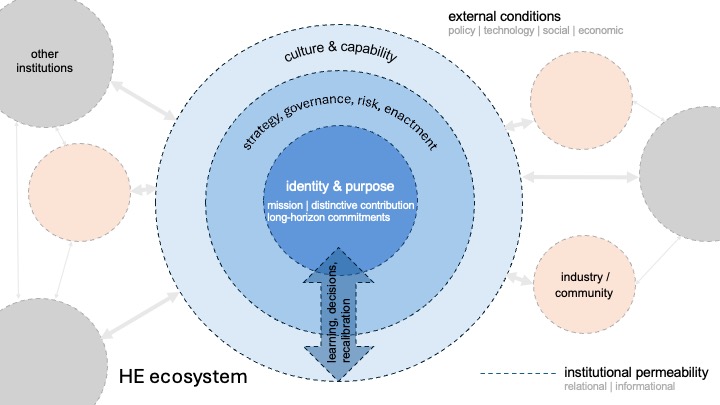
Clarity of identity is foundational to future and change capability. But identity alone is insufficient. Universities must also consider how they are structurally connected to the environments in which they operate, and how those connections shape learning, judgement and action.

Universities operate within dense networks of policy settings, industries, professions, communities, technologies and social expectations. These relationships shape what institutions see, what they learn and what they are able to do. Adaptability requires institutional receptiveness to signals from their networks, particularly when those signals challenge established priorities or sunk investments.

All universities are embedded in ecosystems. The question for me is whether, and if so how, they have deliberately designed their institutional permeability within those ecosystems.

In this article, ecosystem refers to the broader network of relationships within which universities operate. Permeability describes how institutional boundaries are designed so that information, practice and collaboration move across them.

The term ecosystem requires care. Universities are not organic systems whose adaptation unfolds naturally through ecological interaction. They are public institutions with defined responsibilities and accountability obligations. Their adaptability depends on how deliberately they shape the boundaries through which they engage with others.

Universities generate knowledge, data and practice internally that must circulate effectively across academic and administrative domains. Boundaries determine how insight moves in both directions: how developments beyond the institution are taken up, and how internal expertise, research and experience inform strategy and external engagement. When those pathways are intentionally structured, information does not simply accumulate; it travels to places where it can inform deliberation and action.

This deliberate shaping of boundaries is what I mean by permeability, and it is what allows institutions to learn cumulatively rather than episodically. It refers to the intentional design of channels through which ideas, evidence and practice move across institutional domains and between the university and the wider ecosystem.

The following features illustrate how adaptive institutions design permeability in practice. The features are: relational infrastructure, shared expertise and co-design, structured experimentation, and informational permeability.

Relational Infrastructure

Relational infrastructure is one of the clearest expressions of institutional permeability. Most universities already possess substantial relational capacity, though often in uneven and fragmented forms.

Relationships exist across faculties, research centres, advancement teams, marketing functions and alumni networks. Advisory boards are convened, collaborations are formed and partnerships are announced. Yet these relationships frequently develop in parallel rather than in concert. They reflect local priorities, short-term projects or immediate resource needs.

Universities do not consistently treat relational infrastructure as an institutional capability in its own right. Where investment occurs, it is often directed toward short-term outcomes in recruitment, teaching, reputation or philanthropy. These functions are important, but relationships also represent deeper relational capital: accumulated trust, insight and shared experience that can inform institutional direction over time. That capital is not always recognised or mobilised as such.

Fragmentation is common in universities. Partnerships are distributed across organisational silos, information flows are incomplete and brokerage roles are inconsistently embedded in academic and strategic processes. Customer relationship management systems may exist, yet insight does not necessarily circulate beyond the units that generate it. Relational capital remains localised rather than institutional.

Permeability requires a more deliberate approach. It involves cultivating multi-stranded relationships that extend across research, teaching, innovation and engagement. It requires brokerage capacity that connects boundary work to strategic and academic processes. It depends on reciprocity: partnerships sustained through shared purpose and mutual benefit rather than transactional exchange.

Selectivity is equally important. Institutions cannot engage everywhere. The choice of relationships — which sectors, professions, communities and collaborators are prioritised — should align with institutional identity and long-term direction.

Where relational infrastructure is embedded in this way, it influences how the university defines problems, allocates resources and adapts over time. Relational capital becomes consequential when it shapes institutional trajectory rather than remaining an untapped asset.

Shared Expertise and Co-Design

Widespread co-design across an institution is another marker of permeability. It signals that boundaries are sufficiently open — internally and externally — for knowledge to be shaped collaboratively rather than transmitted in one direction.

Adaptability depends not only on access to information, but on how problems are framed and interpreted. Shared design processes influence that framing. When industry partners, community organisations, students and colleagues across faculties contribute to curriculum architecture, research priorities or program review, they reshape the questions being asked as well as the answers being generated. Misalignments between institutional assumptions and lived practice become more visible; constraints and opportunities surface earlier.

The value of co-design lies partly in epistemic expansion. Broadening participation reshapes how evidence is weighed and how institutional judgements are formed. It can narrow the distance between strategy and implementation, between professional practice and academic design, and between central priorities and local realities.

Participation in co-design relies on reciprocity. Contributors engage when they can see that their involvement will matter. For some partners, this may mean access to emerging talent or influence over curriculum direction; for others, it reflects professional stewardship or shared commitment to public purpose. Students may require payment for their time and expertise. Where outcomes are opaque or contributions have little visible effect, engagement weakens.

Not every institutional decision warrants co-design or collaborative shaping. The appropriateness of co-design depends on the object of design and what is at stake. Issues that depend on diverse expertise or shared ownership lend themselves to participatory processes. Others require timely executive judgement within established authority structures.

Structural tensions are unavoidable. Deliberative processes require time and coordination. Power asymmetries can distort participation. Conflicting stakeholder values may surface. Internal co-design — across faculties, central units and leadership — is often as significant as external collaboration. Without alignment across institutional domains, external insight struggles to gain traction.

Shared expertise strengthens institutional adaptability when participation is embedded within processes that connect contribution to institutional purpose.

Structured Experimentation

Adaptive and permeable institutions require structured experimentation: deliberate, bounded forms of variation through which new practices, configurations and partnerships can be tested before wider adoption.

Structured experimentation introduces controlled uncertainty into institutional practice.
Doing this well is demanding: it asks institutions to create space for learning in environments already stretched by workload, compliance and delivery pressures. It creates defined environments in which curriculum models, research translation pathways, partnership structures or organisational arrangements can be trialled at manageable scale. These environments are time-bound and linked to evaluation so that experimentation generates knowledge rather than simply activity.

Many universities already contain elements of this architecture. Curriculum sandpits allow academic teams to prototype new program designs. Applied research laboratories and translational hubs connect scholarly inquiry with partner practice. Incubator and accelerator programs support industry, student and staff enterprise while exposing institutional processes to emerging forms of work. Co-location within innovation precincts brings together researchers, educators, start-ups, established firms and community organisations in shared physical or virtual spaces. When intentionally designed, such precincts connect teaching, research and applied activity, enabling joint problem-solving and iterative development rather than episodic engagement.

These arrangements can be valuable because they make institutional variation visible and discussable. By clarifying what is being attempted, over what period and with what forms of evidence, institutions create conditions for informed judgement. Adaptation often depends on translating structured inquiry into practice.

Structured experimentation also helps manage tempo. Co-design and academic deliberation take time; external developments often move more quickly. Time-bound trials allow provisional responses while evidence accumulates. Institutions can adjust without committing prematurely to wholesale reform.

Interpretation of experiments remains centrally important. Evidence generated through trials must move into spaces where it can be weighed against mission, capacity and long-term direction. Where trials conclude without reflection, promising work dissipates. Where initiatives persist without clear evaluation, portfolios thicken without becoming stronger. Adaptive capacity depends on treating experimentation as part of institutional learning rather than as isolated activity.

When connected to relational infrastructure and aligned with institutional direction, structured experimentation strengthens permeability. It enables institutions to respond to change in ways that are deliberate, proportionate and cumulative.

Informational Permeability

Permeability expands what a university can see. Informational permeability determines whether that visibility sharpens judgement.

Adaptive institutions treat data, evidence and external intelligence as strategic resources. Insight takes multiple forms: institutional data about participation and performance; evaluative evidence from programs and experiments; sector-wide intelligence on labour markets, technology and policy; and knowledge generated through research and professional engagement. Most universities possess these forms of insight in some measure. Fewer integrate them deliberately.

Informational permeability rests on four interrelated practices.

Access. Relevant data and intelligence need to be accessible to those making consequential decisions. Fragmented systems, uneven analytical capability and restricted ownership limit awareness. Foundational data infrastructure and analytical expertise matter here, as does systematic engagement with external intelligence — labour market analytics, professional standards, technological developments and global higher education trends — rather than reliance on informal networks.

Interpretation. Insight requires collective sense-making. Patterns in student progression, research performance, demographic change, partnership outcomes or industry demand require contextual reading. Interpretation depends on forums in which evidence is examined in light of institutional purpose and capacity.

Translation. Information must be converted into practical implications. Labour market analysis may inform portfolio decisions; research capability mapping may shape partnership strategy; demographic shifts may alter recruitment and support models; technological developments may prompt redesign of services or investment priorities.

Use. Insight acquires institutional value when it influences decisions over time. This includes evaluating initiatives against explicit aims, discontinuing activity where outcomes are weak, consolidating where impact is demonstrable and adjusting where conditions shift. It also requires distribution: ensuring that relevant parts of the institution engage with and apply insight appropriately.

Together, these practices determine whether information shapes decisions about what to invest in, what to stop and what to reshape, or simply sits alongside them.

Arizona State University provides a useful illustration of informational permeability. Its investment in integrated student data systems linking progression analytics, curriculum design and support services has strengthened institutional responsiveness. The significance lies not only in technology, but in the alignment between information flows and institutional priorities. Insight informs redesign; redesign generates further insight; learning accumulates.

When data and intelligence remain fragmented, institutions respond in fragments.
In practice, institutions vary in how willing they are to confront what such insights reveal, particularly when it challenges established priorities or sunk investments.
When informational permeability is designed deliberately, insight travels, accumulates and sharpens adaptive capacity.

Conclusion: From Permeability to Capability

Adaptive capacity depends on the alignment between identity and permeability. Clarity of purpose anchors direction; permeability expands awareness. Together they shape the conditions under which institutions can learn deliberately rather than react episodically.

Relational infrastructure, shared expertise, structured experimentation and informational permeability broaden what institutions can see, test and understand. They create channels through which insight enters and circulates. Awareness alone does not constitute capability. Institutions must also be prepared to engage seriously with what that insight reveals, particularly when it challenges established priorities or settled assumptions.

The implications extend beyond individual institutions. A differentiated system strengthens permeability when institutions cultivate relationships and informational practices aligned with their distinctive missions. Policy settings are therefore important. When regulatory and funding frameworks assume uniform portfolios, relational and informational designs converge. When they enable differentiated contribution, permeability can deepen rather than fragment.

Many institutions can sense what is changing around them. Far fewer have deliberately designed the pathways that allow insight to accumulate, and the resolve to act on it thoughtfully.

The next article turns to how universities can design processes that translate institutional learning into deliberate, proportionate action over time.

Facebooktwitterredditpinterestlinkedinmail

AI adoption and the reshaping of early-career capability – a shared challenge for higher education and industry

Last week I delivered the opening keynote at the Graduate Employability: Insights to Impact Forum hosted by Swinburne on how generative and agentic AI are reshaping early-career work, and how industry, universities and students can be better prepared for it. I’ve had a few days to reflect, and I’m ready to share some thoughts.

The dominant media-driven narratives remain polarised. Either AI will eliminate graduate jobs (“the graduate jobpocalypse!”, “a robot stole my internship!”), or the AI bubble will burst, forcing a dramatic correction, a decline in organisational use, and the re-hiring of all the graduates we replaced with robots.

Clear-eyed analysis of evidence emerging from my employer survey research in Australia, international workforce analyses out of Stanford and Harvard, and recent graduate outcomes data suggests a far more complex picture — one that requires a nuanced and collaborative response.

In the United States, entry-level roles in many professional areas are in decline, partly attributable to AI adoption. In Australia, we can see the beginning of possible declines in graduate opportunities in bellwether disciplines like IT and law. However, my research with Australian employers suggests AI adoption is uneven. Its impact varies by sector, regulatory context, organisational size, leadership preference and task profile. Across these differences, however, some structural shifts are becoming clearer.

Routine, programmable tasks are declining. Expectations around judgement, oversight, integration and complex human interaction are rising — often far earlier in career trajectories than before. Entry-level roles are becoming broader, more cognitively demanding and less scaffolded. For instance, entry-level supply chain and logistics professionals are being asked to problem-solve anomalies and exceptions rather than beginning their careers with foundational data updating, reporting and compliance tracking.

Entry-level workforce shifts are happening, but I’m not seeing a jobpocalypse.

Many of us will have heard stories of organisations keen to take advantage of perceived AI efficiencies, moving quickly to adopt AI and reducing graduate hiring. Now, with greater AI maturity and clearer insights into organisational capability, public reporting suggests IBM and others are making more room for entry-level roles again.

For decades, many organisations have relied on pyramid-shaped workforce models, where early-career roles were places to perform straightforward tasks and also provided protected space in which tacit knowledge and professional judgement could be formed. When AI is introduced primarily as a tool for automation, without redesigning those developmental pathways, capability formation becomes compressed. We begin to see the emergence of more “diamond-shaped” structures, with fewer entry points and heavier reliance on mid-career expertise.

This approach may improve short-term efficiency (though, as I’ll share below, mounting evidence suggests otherwise). It certainly does not support long-term capability sustainability, and many organisations are now recognising this.

A very recent workflow study from Stanford examined software development workflows and tasks performed by AI and people. It found that full automation — for example, “write the code for this app” or “write the analytical report for Y” — often introduces significant inefficiencies through human checking and rework at the end. By contrast, where humans retain oversight and use AI to augment defined components of work within a workflow (staying in control and delegating programmable sub-steps such as data cleaning or boilerplate code), productivity gains are much stronger.

The study found that the automation approach resulted in an 18% productivity decline, while the augmentation approach resulted in a 24% productivity increase.

For educators, these findings shift the conversation beyond AI literacy.

Graduates do need technical capability and AI literacy (“how to get AI to do what I need and ensure the output is high quality”). More critically, however, they require AI fluency: the capacity to use AI for augmentation — knowing when to use it and when not to — exercising domain judgement, interrogating outputs, understanding limitations, integrating ethical reasoning, and achieving the best overall outcome possible.

As one industry panellist at the forum observed:

“AI isn’t replacing human judgement. It’s making the absence of judgement more visible.”

The question for universities is how we integrate these fluencies into our courses, even as industry is concurrently working out how best to augment rather than automate with AI — and as AI capability itself continues to advance rapidly. This is a strong signal that we need to move away from legacy, slow-moving “curriculum in boxes” towards more advanced forms of authentic learning and teaching. Further, we need to go beyond episodic industry engagement to deep, reciprocally beneficial partnerships, collaborating to redesign the way professional capability is developed and talent pipelines are formed.

We can’t get away with tinkering at the edges of curriculum. This is a deep design challenge to which higher education and industry need to commit.

Facebooktwitterredditpinterestlinkedinmail

Identity Before Adaptability: Laying the Foundations for Future and Change Capability in Higher Education

In my previous post, I argued that a central challenge facing universities in these times of flux is not resistance to change, but a lack of future and change capability. By this I mean the institutional ability to decide, deliberately and in time, when and what to change and when and what not to, and then to act on those decisions. This second piece considers a foundational condition for building that capability: clarity of purpose and identity.

Australian universities face constant pressure to adapt. Artificial intelligence, funding volatility, policy shifts and changes in student demand all demand response. Many commentators have pointed out that institutions are not built for speed or sustained change, and discussions about why often focus on process, structure, and culture. While these are important factors, I suggest that a key difficulty lies at the level of strategy, or deeper still, at the level of identity. Without a clear sense of purpose in an institution, too many changes appear equally urgent, equally plausible, and equally unavoidable, making coherent choice increasingly difficult.

Identity before adaptability

At the institutional level, future and change capability begins with shared clarity about what an institution exists to do, what it will prioritise, and what it will choose not to pursue as conditions evolve. Technical capability, financial capacity, and a skilled workforce all matter. However, in the absence of a coherent identity, even well-resourced institutions struggle to translate capability into sustained direction.

By identity I mean a clear articulation of purpose and long-term priorities that functions as a decision framework, with strategic and operational consequences. Identity shapes what we stop, what we scale, and how we allocate constrained time, budget, and political capital. It also informs how we respond to external pressure and internal opportunity.

As with individual identity, institutional identity emerges from a combination of self-awareness and contextual awareness. It synthesises understanding of distinctive strengths and values with knowledge of community needs, policy directions, and emerging opportunities. Institutional identities are not slogans or branding exercises. They are made visible through educational offerings, research agendas, engagement practices, and partnerships.

Importantly, institutional identity is primarily horizontal rather than vertical. It is not about tiering institutions by status or performance, but about purpose and mission. Institutions might orient themselves toward online lifelong professional learning; integrated academic and work-based education; modular skills development; deep regional engagement; or missions relating to environmental sustainability, health, or security. These are choices about contribution, not rank.

The future is diverse and fast-changing. It is increasingly clear that a single, resource-constrained institution cannot do everything or respond to everything effectively. Rather than maximising breadth, institutions need to make deliberate choices about a smaller number of priorities and pursue them well. Paradoxically, this selectivity strengthens adaptability by reducing noise and clarifying what matters when change is required.

It should be noted that clarity of identity does not remove short-term pressure. Universities will continue to face urgent demands arising from funding constraints, workforce challenges, and policy shifts. What identity provides is a basis for judgement: deciding which pressures to absorb, which to resist, and which warrant deeper adaptation. Without this shared basis, institutions risk treating all pressures as equally urgent, increasing fragmentation and strategic drift.

Starting with the sector: who are we and what are we for?

Institutional identity does not develop in isolation. Universities operate within systems that both enable and constrain what is possible.

At the sector level, fundamental questions remain unresolved: what does Australian society expect higher education to contribute over the long term? How does the sector understand its collective role in meeting those expectations? How can we design a system capable of responding to increasing complexity in technology, workforce demand, and social need?

Sector-level clarity is important because it shapes how institutions interpret external signals such as funding incentives, regulation, rankings, and reputational cues. Government policy settings play a significant role in shaping what kinds of institutional directions are seen as legitimate, fundable, and sustainable. While these settings inevitably shift with political priorities, they are most effective when underpinned by a shared understanding of what higher education is for and how it operates. In the absence of that foundation, short-term signals dominate and coherence erodes at both system and institutional levels.

Sector-level identity enables institutional positioning. Where it is weak or ambiguous, institutional identity is progressively diluted, and strategies become increasingly reactive.

The cost of trying to be everything

In many respects, Australian universities are strikingly similar. Many pursue growth in the same markets, compete for the same student cohorts, and seek recognition through the same measures of success. The result is duplication, dispersed capability, and rising internal complexity.

In some ways, duplication and breadth of activity are not problematic. In complex systems, some redundancy and slack can support experimentation, learning, and innovation. Difficulties arise when breadth reflects accumulated activity rather than deliberate choice, and when few activities are ever stopped. Under these conditions, inefficiency becomes structural rather than strategic. Cautious expansion happens across many fronts. Institutions grow widely rather than deeply, diluting focus and making it harder to sustain excellence or adapt coherently.

There are, however, signs of alternative approaches within the Australian system. Some institutions have begun aligning strategy around a smaller number of distinctive commitments, such as focused research concentrations, deep regional engagement, or industry-embedded education. Smaller providers often operate with clearer specialisation, orienting programs and partnerships around specific missions.

In these cases, identity starts to function as a lived decision framework rather than an abstract statement. Choices about investment, partnership, growth, and withdrawal are made with reference to mission rather than opportunity alone. This provides clearer signals to staff, students, and partners about what the institution is for and how success should be understood.

Such approaches involve trade-offs. They may require declining opportunities, narrowing scope, or resisting sector-wide trends. Yet they can also reduce internal friction, strengthen coherence across teaching, research, and engagement, and support more confident long-term investment. Where clarity is present, institutions are better positioned to adapt without repeatedly resetting direction.

Time horizons, strategic lurches, leadership, and trust

Institutional identity work unfolds over much longer horizons than those that typically govern university decision making. Three-year government terms, five-year strategic plans, executive contracts, and council appointments create short cycles of attention and accountability. In the absence of an enduring sense of purpose, these cycles can produce not strategic drift but strategic lurching: repeated shifts in direction as institutions respond to successive policy signals, leadership preferences, or funding pressures.

A coherent institutional identity evolves over time but provides continuity across these transitions. It enables institutions to adjust course without repeatedly redefining purpose, supporting cumulative rather than episodic strategy.

Clarity and continuity of identity are closely linked to trust. When priorities are diffuse or frequently changing, staff learn that effort invested in one direction may be under-supported or reversed. For students and partners, instability makes informed choices more difficult. For governments and communities, unclear identity weakens confidence that public investment aligns with public purpose.

Trust is built through consistency of intent. Adaptation is more likely to be supported when guided by stable institutional commitments. Identity functions as a durable reference point: core commitments remain relatively enduring, while their expression develops through evidence, experimentation, and learning. Identity work is therefore an ongoing institutional practice rather than a one-off strategic exercise.

Differentiation and the Australian policy context

A sector composed of institutions with clear, consistent, and complementary identities is a differentiated system. While differentiation is widely endorsed in principle, it is weakly supported by current Australian policy settings. Funding, regulatory, and accountability frameworks largely assume institutional homogeneity, while rankings reinforce convergence by rewarding comprehensive activity across a narrow set of indicators. Together, these dynamics encourage institutions to look alike and compete on similar terms.

The Australian Universities Accord has reopened important questions about sector purpose and coherence. One opportunity lies in moving beyond uniform expectations toward a more differentiated ecosystem. Mission-based or bespoke institutional compacts are often proposed as a mechanism for achieving this.

Mission-based funding has been widely criticised in Australia, and not without reason. In theory, such compacts align funding and accountability with clearly articulated missions rather than generic performance metrics. In practice, they have often drifted toward compliance or micromanagement, limiting their capacity to genuinely support differentiation.

International experience suggests that more effective approaches focus on a small number of long-horizon outcomes, include independent review, allocate meaningful funding to missions, and operate on stable review cycles. Differentiation can sit above a shared baseline of agreed principles around quality, equity, and regional provision. Specialisation at institutional level need not reduce student choice at system level when supported by credit portability, shared curricula, and cross-institution enrolment mechanisms. Rankings will continue to shape reputation, but institutions can rebalance internal success measures toward mission outcomes to reduce disproportionate strategic responses to marginal rank movements.

Historically, Australian higher education policy has prioritised comparability, growth, and comprehensiveness. While these settings have supported expansion and stability, they also make it difficult for institutions to pursue distinctive long-term missions with confidence or to adapt in conditions of ongoing complexity.

The work of institutional identity development

Institutional identity development is difficult work. It requires confronting legacy assumptions about breadth and growth, undertaking honest assessment of strengths and constraints, and making decisions that may be unpopular. Sustaining identity over time requires leadership and governance arrangements that treat purpose as enduring institutional work rather than branding or a static element of a strategic plan.

From identity to capability

A more future and change capable higher education system will not be achieved by expecting every institution to do everything, nor by relying on short cycles of reform or performance pressure alone. It requires institutions with clear, enduring identities that guide coherent choices over time, and a policy environment that enables difference without fragmenting the system as a whole.

When institutional purpose is stable, adaptation becomes more deliberate, trust more likely, and collaboration more feasible. Differentiation, understood not as hierarchy but as complementarity, allows institutions to contribute in distinct ways while collectively meeting public needs. In this sense, identity is not a constraint on adaptability but its precondition, providing a stable basis for judgement as universities navigate uncertainty, leadership change, and shifting societal expectations.

The next piece in this series turns to how clarity of identity can be translated into action and adaptability.

Facebooktwitterredditpinterestlinkedinmail

In these disruptive times, universities don’t need to be less resistant to change.

They do need a more advanced kind of capability for change.

As we embark on another working year, I’ve been reflecting on the challenges and opportunities facing universities in 2026. And yes, me being me it’s turned into a 1,700 word theory of change piece… there is also a conceptual model, and I have some practical ideas about implementation, which I’ll save to share later if they’re useful. But here’s the introductory piece.

Universities: facing disruptive change and increasing pressure to change
The higher education sector is now thoroughly familiar with the ‘universities are facing disruptive change’ narrative. Today, that narrative is most often associated with the sudden ubiquity of generative AI; before that, it was the pandemic. The underlying concern, however, remains the same: the business sustainability of universities. Other pressures in Australian higher education include policy-led financial constraints and shifting funding models, and intensifying institutional competition from within the sector and elsewhere. Taken together, these pressures don’t just strain university finances. They shape institutional decision-making, risk tolerance, and the kinds of educational trade-offs universities feel compelled to make.

This disruption narrative is often conflated with a related but distinct one: that higher education itself needs to change. This second narrative points to growing mismatches between what universities do and offer and what their stakeholders expect. In 2025, the decline in social license and erosion of public confidence and trust were key issues for the sector, driven by perceptions that universities have become overly corporatised and out of touch with community concerns. Some of the criticisms relate to universities’ difficulties keeping up with an increasingly diverse student population, meeting evolving learning needs, and catering to rapidly changing workforce skill requirements.

How can our students be more adaptable if we aren’t?
Across roles and initiatives that I’ve pursued in my career, there is a recurrent theme: leading and enabling change within institutions, with the overall aim of supporting learners to become more future- and change-capable. For instance, at my current institution I’ve worked with educators to embed work-integrated learning at every level of every undergraduate course; I’ve infused career development learning into the curriculum with positive impact on student engagement, retention, success and graduate outcomes; and most recently, I’ve been using data to personalise learning and student support within and beyond the curriculum.

Much of this work has involved connecting parts of the institution that do not naturally collaborate, partnering with industry, community, educators, and learners themselves, and working across entrenched silos and legacy processes in pursuit of transformation. Across these initiatives, the common challenge has been less about persuading individuals to change (although stakeholder engagement has been centrally important), and more about enabling universities to act coherently and responsively. Within universities we’ve all had innumerable ‘process wagging the dog’, ‘computer says no’, ‘ivory tower syndrome’ and ‘fiefdom mentality’ experiences that militate against change.

At a higher level, what I have noticed through my experiences is that to develop future-and-change capable learners and graduates who will be successful in their lives and careers, you need future-and-change capable educators, and in turn future-and-change capable institutions (and a policy context that enables all of the above). Put another way, it is very difficult to teach students to be proactive and adaptable when their educational experiences, programs, processes, structures and environments they encounter are reactive and rigid.

Change resistance: Not the enemy, necessarily
Universities are often described as change-resistant, and this is usually framed as a criticism. Actually, and this may seem to run counter to what I’ve just said – bear with me – I think that some change resistance in higher education can be a good thing.
Commitments to educational quality, consistency, and accountability are essential. Quality assurance requirements play a legitimate and necessary role in maintaining trust in higher education. Too much change leads to exhaustion and confusion.

Here’s where the nuance comes in. I’d argue that universities need to build our capability to know when (and how) to flex, and when (and how) not to. In many ways, we’ve erred on the side of non-change for a long time. Over time, layers of bureaucracy and administrivia have accumulated – often in response to past risks or policy pressures – without being revisited or tested against their ongoing value. I suggest that some of these structures are no longer proportionate to the quality aims they were designed to serve, yet they continue to shape what is possible, how quickly institutions can move, and where effort is expended. A good example here is course development and accreditation processes, which can sometimes be so glacially slow that once finally approved, a new course immediately needs to be redesigned to be relevant.

There is an important difference here between principled resistance, grounded in educational quality, equity, and accountability, and inertial resistance that persists simply because systems are difficult to change. In this sense, selective resistance is not a liability but a contributor to public trust and social licence, signalling that universities do not abandon core values in the face of every new pressure.

The deeper problem isn’t resistance to change, but that universities are not sufficiently future-and-change capable. Future-and-change capability is a distinct institutional capability, infused into all of our core activities at every level of the institution, that shapes how universities navigate uncertainty over time.

This isn’t another call for university agility, innovation, or cultural change alone. It is an argument about the fundamentals of institutional design – about embedding adaptive capacity into governance, systems, and everyday decision-making. It is a set of institutional capabilities embedded in structures, processes, and ways of working. A future-and-change capable university can make good, informed decisions with the future and the present in mind at every level of the institution, to change and adapt where needed or stay put when this is the best course of action.


Reactive, sustaining and transformative change
Universities can and do change. However, much change in universities remains reactive and mostly unexamined, triggered by external shocks and requiring extraordinary actions and measures. From the inside, reactive change can feel like a sudden sideways lurch: priorities shift, funding is reallocated, roles and structures are reshaped. The aim of reactive change is not transformation. It is usually about returning to a viable version of the status quo. Over time, this reactive pattern erodes staff trust, depletes morale, and weakens institutional memory, making subsequent change harder rather than easier.

Universities also pursue what might be described as sustaining change: proactive, incremental improvements intended to enhance existing practices, programs, or systems. While these initiatives are frequently well-designed and evidence-informed, they are less often structurally protected. Unlike routine continuous improvement, sustaining change often challenges existing power arrangements, resource allocations, or performance metrics, which can make it more vulnerable. When priorities shift, leaders move on, or funding and policy settings change, sustaining change initiatives can stall or disappear, sometimes irrespective of their impact or value. Often, what is missing is structural protection: stable funding, formal governance ownership, embedded roles, and alignment with core institutional processes.

It seems many of our institutions struggle to do any form of change particularly well. Reactive change is exhausting, disruptive and sometimes frightening for those affected. Sustaining change can be fragile and difficult to maintain over time. Change often seems to be something universities endure, rather than something they are structurally equipped to navigate, learn from, and build upon.


The deeper problem is not that universities resist change, but that they lack the capability to decide – deliberately, proportionately, and in time – when and how to change and when not to, and then to carry those actions through.

There are, of course, institutions that have pursued more substantial transformations successfully, including new models and modes of delivery, large-scale pedagogic change, deeply data-informed approaches to curriculum and student support, short-form credentials, and co-ordinated tertiary offerings across vocational and higher education. What makes these examples compelling is that these are instances where, despite universities’ change resistant and risk averse reputations, they have taken larger risks proactively in pursuit of meaningful change.

Also, we find in many of these innovations evidence that institutions have sought to meet sector policy priorities and business sustainability imperatives concurrently, while keeping core ideas around HE values, identity and purpose at the forefront (which might also, incidentally, help rebuild our social license). Success here takes courage and outstanding leadership, along with the right enabling conditions.

What is future-and-change capability? (AKA I finally get to the point)
But my thinking keeps returning to how higher education institutions (and the sector as a whole) can start to become more future-and-change capable in an ongoing way. Innovation cannot be a one-off project or even a periodic endeavour for universities, as disruptors, change pressures and opportunities continually emerge. Yet for many institutions, there remains a significant gap between acknowledging this need and having the institutional capability required to act on it consistently.

Proactive, conscious, deliberate and ongoing approaches to navigating change must become normalised in higher education. This begins with ensuring that we are continually looking around and ahead, experimenting, and connecting meaningfully with our communities, then interpreting what we are seeing. We need to sense-make actively from these experiences and make informed decisions about how to act that are also grounded in who we are and why we exist.

Universities also need to ensure that we have the capability to act – that we are equipped and ready to transform, adapt, or deliberately hold steady, and that we learn from our actions. This means building feedback loops that allow us to assess outcomes, adjust course, and sustain effective change over time, rather than repeatedly resetting in response to each new pressure.

I know that what I am calling for is a huge challenge for institutions and the sector, given the complexity of our internal and external contexts, and the constraints that we face. I also think it’s central to our survival and our ongoing place in society.

It means supporting students and staff to develop their own adaptive capabilities, while also building enabling adaptive institutional structures and processes. We must also recognise that no institution can do this work in isolation. Connecting and collaborating across boundaries – with other institutions, communities, and policy makers – is essential to building and sustaining an adaptive educational ecosystem. For senior leaders, this means shifting some of their attention from each initiative or transformational program to the harder work of building enduring institutional capabilities that allow universities to adapt with integrity and purpose over time.

If higher education is serious about preparing learners for uncertain futures, then the sector itself must become more future- and change-capable. This will never occur through episodic reform, but by building aligned, adaptive capability and action across learners, educators, institutions, and the systems that shape them.

—-
This piece could be the first in a short series exploring what future-and-change capability could mean for higher education institutions and the sector. As I mentioned up front I have further thoughts about what future-and-change capability involves, what it could look like in practice institutionally and sectorally, and how to surmount the challenges involved in becoming more future-and-change capable.

I’m keen to hear from colleagues about your experiences of institutional change, particularly when it has been effective (or has had effective elements), or where ongoing adaptation has been a feature. Are there examples that you know of from higher education or other highly regulated sectors containing large organisations where continual adaptation is done well? Please get in touch if you’d like.


NB. I wrote this post as a scholar of higher education, without critique of any particular institution or initiative in mind.

AI use and post development disclosure: I wrote a first draft of this post and asked ChatGPT to edit it critically. I reviewed its changes and additions and threw them all out because (i) it failed to grasp important nuances in the argument and (ii) its contributions were all in its own (very characteristic) writing style, despite my requests that it follow mine.

I wrote a second draft and then asked ChatGPT to critique the 2nd draft paragraph by paragraph, looking for errors in argumentation and editorial issues. I made some minor editorial changes based on its recommendations. I shared this 3rd draft with some close friends and colleagues for their thoughts and made some more changes before publishing. This post is organically me, including any errors or annoying em dashes you see.

Facebooktwitterredditpinterestlinkedinmail

Learning and working through social networks: Still a (mostly) untapped opportunity for higher education

TLDR: My Australian National Senior Teaching Fellowship report is now out and available for download. My fellowship explores the roles that social networks play in graduate employability, and how universities can foster social network capability through interventions at curricular, pedagogic, and organisational levels.

My fellowship findings and resources will be of interest to Australian university leaders who are developing strategies in response to the National Priorities and Industry Linkage Fund, and to educators who are designing or reviewing degree programs.

Readers can access the connectedness reflection tool for educators for free. I also offer facilitated sessions to support educators with curriculum development and review, and strategic industry partnership development. Please get touch if you’d like to find out more.

Full article:

As many of you know, I’m interested in how education can ensure that learners are prepared for the future (and increasingly the now!) of life and work. Some of my research is about the capabilities that individuals can develop – so-called ’21st century’ skills, and the learning & teaching approaches that foster these. But I am also interested in other factors involved in future-capability, beyond individual skills.

For the last five years, through my Australian National Senior Teaching Fellowship Graduate Employability 2.0, along with a range of other research grants, I have been exploring how individuals, educators and educational institutions can enhance and make the most of social networks for learning and career success. I’ve discovered this goes far beyond ‘networking’ and having a polished LinkedIn profile.

How can individuals benefit from social networks?

My research suggests that there are at least three ways in which individuals can benefit from social connectedness in 21st century careers. They are:

(1) networks for career development (the one we usually think of) – activating social networks for career development through mentorship, access to resources or opportunities

(2) networks for learning – learning new skills by collaborating with others, or by sourcing information, knowledge or capabilities from others

(3) networks for innovation and problem-solving – solving problems or creating new knowledge by collaborating with, or sourcing information, knowledge or capabilities from, others, particularly those from a different discipline or context

Developing and using networks for learning and innovation / problem solving are centrally important to how 21st century society works.

What does higher education need to do?

Both the capabilities needed for social networks and the social networks themselves can, and should, be developed through higher education. The good news is that over the last few years universities have started to appreciate the roles that networks play in student career development and graduate employability. More and more students are learning the basics of networking for career development while they are undergraduates, which sets a good foundation for social network development over time.

However, learning, problem solving and innovation through social networks are still much less likely to be included in curricula. Since last year much teaching has moved online, but students are still being allocated into teams of 4 with their same-discipline course peers (in a break-out room in Zoom or Teams) to engage in learning. This approach is useful for some outcomes, but it doesn’t get at the real scenarios, processes and outcomes through which graduates will end up adding value.

There are some great exemplars of authentic and ‘free-range’, interdisciplinary and socially networked learning out there — e.g., some kinds of work integrated learning, enterprise and entrepreneurship learning, and research-based learning experiences. I cheer internally every time I hear about one. But this learning is by no means ubiquitous.

The main reasons seem to be that while valuable, it can be more resource-intensive and risky to deliver than classroom-based learning, challenging to arrange logistically and financially, and difficult to assess.

What next steps can educators take?

For social network-based learning to occur effectively and consistently, certain educational elements relating to curriculum, pedagogy and layers of institutional connectedness need to line up. You can access the connectedness reflection tool for educators for free to start to characterise the strengths and opportunities of your program, School, or institution.

More broadly, educational programs and institutions need to be well-connected with their communities and social ecosystems, something which many universities still struggle with. My research interviewees described the university either as a ‘walled garden’ or a series of siloes – neither of which support social network-based learning. My book Higher Education and the Future of Graduate Employability – A Connectedness Learning Approach deals with these issues in more detail, including some case studies from different institutions.

For more information

I encourage readers to check out my fellowship resources:

Final Fellowship Report – Graduate Employability 2.0: Enhancing the Connectedness of Learners, Programs and Higher Education Institutions
The Graduate Employability 2.0 model and framework
Connectedness Reflection Tool for Educators
Fact Sheets

I also offer facilitated sessions to support educators with curriculum development and review, and strategic industry partnership development. Please get touch if you’d like to find out more.Facebooktwitterredditpinterestlinkedinmail

Making career changes – COVID-19 and the future of work

I was on Australian Channel 7 Sunrise television yesterday talking about the future of work, and what it means for career changers – thinking about where the opportunities are, and what can people do to make the most of them.

I only had a few minutes on TV and I had a lot more to share, so I’ve written up this blog post.

The topics I’ll cover in this post are:

  1. Why is it that so many people thinking of changing careers?
  2. Where are the job opportunities right now?
  3. How do people maximise their career adaptability in order to successfully change careers?
  4. What will work look like in the future?
  5. What about career opportunities beyond the immediate future?

Why is it that so many people thinking of changing careers?

According to survey research conducted by ING Future Focus, about 3 million people in Australia are thinking of changing careers post-pandemic. The research found 35 per cent of surveyed Australians wanted a new job after COVID-19, and 17 per cent were rethinking their career path entirely.

I think the reason for this is twofold. First, the ABS reports that about 1 million Australian jobs have been lost since the beginning of the pandemic, affecting disproportionately hospitality and retail jobs, casual workers, young people, women, and minorities. The rest of us are working differently than ever before – as businesses have moved their operations online, many of us have been working from home. New roles have also emerged very quickly. Back in February, I’ll bet no one would have guessed that they’d be undertaking tasks around crisis management, staged return to work management, or working from home co-ordination. I think working from home is set to continue, as businesses and organisations reinvent themselves permanently as more online and less ‘bricks and mortar’.

The second reason is that while we’ve been experiencing this instability, we’ve been at home with some time and space to reflect, and to think about what our options could be. Some will be prioritising financial safety in their reflections, and others will be thinking about where the opportunities are for them in the new world of work.

Where are the job opportunities right now?

At present I’d describe the job opportunities out there are being about core needs – safety, food, health, and entertainment while at home. The opportunities are what you’d expect – many job roles in healthcare and social care, in essential retail (supermarkets), and in logistics and delivery work. As the economy opens up more, there will be more opportunities in retail again, but hospitality and tourism are likely to be rocky labour markets for some time.

There is also an interesting trend around big companies like banks and telcos returning their global operations to onshore, so there are more Australian jobs in call centres, back-end operations, data processing, and IT. My little sister just last week got her first full-time job working at a major insurance company processing claims because the company brought these functions back to Australia.

How do people maximise their career adaptability in order to successfully change careers?

Career change is a multi-step process. The first step is to make space for yourself to think and act. No one who is under severe financial stress can think strategically or creatively about their careers, so ensure that you have done everything you can to ensure your financial safety first. This might be applying for government benefits, talking to your bank to stop mortgage payments temporarily, or making the most of the job opportunities I’ve described above, even though it may not align 100% with where you want to go.

The second step is to start to think about yourself not in terms of your job title, but in terms of the values, strengths and capabilities that you have. For instance, someone who works in hospitality might have great interpersonal skills and abilities to resolve conflict, and find great satisfaction in that. Engineers tend to be great project managers with well-developed analytical capabilities. It can sometimes be difficult to reframe in this way by yourself, and in this case talking with other people (such as colleagues or friends who are prepared to be honest and up-front with you) can help to help illuminate what your particular strengths are. Professional career counsellors are also great at helping with this process.

From your reframing, you can then go ahead and start to explore opportunities that are out there, or that you might be able to create. Speaking of creating opportunities, now is probably not a good time to throw everything you have into a new venture, but it is a great time to start exploring side gigs if you’ve got an idea for one (virtual clutter organising anyone? With all this working from home I really need someone to Marie Kondo my computer!)

You may also need to upskill or reskill for new opportunities. You can often start the skilling process informally and cheaply / free through online platforms like Linkedin Learning, Youtube, or MOOCs through Coursera. If you want to get a formal credential, and this can be an advantage in the jobs market, TAFES and universities are currently offering subsidised 6-month certificate courses at undergraduate and postgraduate level in areas of national priority such as aged care, information systems, and education. Griffith University, where I work, is offering certificates in cybersecurity and data analytics, which are good areas of jobs growth.

For more on career planning in an era of disruption, you can check out my blog post on this topic here.

What will work look like in the future?

I’ve been involved in several research projects investigating the future of work. While none of them predicted the COVID-19 pandemic specifically, we did predict that there would be major changes to the world of work over the next few years. My research suggests that change is actually going to become the ‘new normal’, and many of us will need to reinvent ourselves professionally multiple times throughout the course of our careers.

We’ve actually got a ‘double whammy’ of change happening right now. We’re in a pandemic, and we’re also at the beginning of the 4th industrial revolution[1]. But the good news is that history suggests we’re fairly resilient to these kinds of changes. For instance, the Plague in the Middle Ages in the late 1300s led to the Renaissance in the 1400s – an unprecedented time of expansion in science, culture and the arts.

Our 21st century post-pandemic expansion is going to be digital. It’ll be about things like artificial intelligence, robotics, augmented reality, and cloud computing. On the basis of our experiences in the last few months I suspect and hope it will also be about reconnection with community, social engagement, and environmental sustainability.

What about career opportunities beyond the immediate future?

At the moment the economy is in a deep recession. Even while the recession is going on, COVID-19 is driving enormous digital transformation. When the economy recovers, there will be even more digital innovation across many fields.

In the research project 100 Jobs of the Future, we interviewed experts and asked them to identify key trends and advances in their fields, and project what key work opportunities in the next 10-20 years might be. The 100 jobs are meant to inspire and help young people (and not so young people!) see possibilities in the next wave of careers.

There is a digital thread that runs through 99 of the 100 jobs[2] that were generated through the research. But for those of us who aren’t full-stack programmers and have no desire to be, there is good news as well. Only about 20 of the future jobs were digitally intensive – ones around things like cybersecurity, machine learning programming, and quantum computing development.

The rest of jobs rely on the use of digital technology in various ways, particularly to connect with other people – to care, to educate, to persuade or inform – or to help with practical tasks like food production or building or cleaning. Others key themes that ran through some of the jobs were scientific advancement, and advanced use of data.

You can browse all 100 jobs or do the jobs explorer quiz at the website 100jobsofthefuture.com, but here is a sample of them by key theme.

Connection with people jobs – Nostalgist: This is a role in aged and dementia care. Nostalgists work with people to recreate experiences and contexts from bygone eras to help them feel safe.  Other people jobs include: Virtual tourism manager, personal brand and content manager, digital memorialist, 100 year counsellor, cyborg psychologist.

Practical jobs – Biofilm installer: Biofilm installers are a kind of specialised plumber who installs a layer of good bacteria into pipes and waterways to help break down waste. Other practical jobs: Robot or drone mechanic, energy and data systems installer

Organised jobs – Virtual clutter organiser: This one’s for those of us who have ever felt a little overwhelmed about the volume of your email, online photos or other data. You can hire a virtual clutter organiser to sort out your online data, Marie Kondo style

Science jobs – Biomimicry innovator, de-extinction geneticist, terraforming microbiologist

Health jobs – Nutri-gutome consultant, genetics coach, data-informed diagnostician

Outside jobs– Cricket farmer, digital apiarist, agroecological farmer

Creative jobs – Autonomous vehicle profile designer, swarm artist

Jobs I would personally love to do out of the 100 jobs: Trendwatcher, fusionist (someone who brings people from different disciplines together to solve problems and generate ideas), lifelong education advisor (and I’m already doing all three of these!)


[1] Researchers argue that there have actually been 3 other industrial revolutions – the first (and most famous) one kicked off in the 1700s with people moving off the land and the invention of the steam engine.

[2] If you were wondering about the non-digital 100th job, it’s Analogue Experience Guide – someone who helps people disconnect from their devices and reconnect with nature.

Facebooktwitterredditpinterestlinkedinmail

100 Jobs of The Future: what are the job roles that could be created in the next few years?

Screen Shot 2019-07-24 at 3.07.28 pm

Media reports and scholarly literature alike tend to emphasise the jobs that might / will disappear over the next few years under the influence of automation and artificial intelligence. Some reports suggest that as many as 50% of job roles will disappear. Others suggest that work might eventually become a thing of the past entirely, resulting in either a leisure-based utopia and universal income for humans, or the end of society, economy, and possibly even civilisation as we know it.

Over the past 5-6 years that I’ve been active in this area of research, I’ve worked to temper these claims. Yes, some roles have disappeared already (typesetter, switchboard operator, toll and parking fee collector…) It is very likely that other roles will follow behind them in the next few years (tax accountants, warehouse jobs, many types of customer service roles, telemarketers [yay!]…) Other jobs roles will continue to exist, but the tasks inside those roles will become more about (i) interacting with technology, and (ii) things that only humans can do (or things that it is too expensive for machines to do).

I’ve always wanted to know about the other side of this story: Could there be jobs that become more common? Will there be entirely new jobs created?
This is what the ‘100 jobs of the future’ research project is about.

I (at Griffith University) worked with colleagues from Deakin University (Russel Tytler and Peta White), with funding supplied by Ford Australia, to try to figure out what the ‘uniquely human’ job roles might be in the next 20-30 years, including some entirely new roles. We explicitly wanted to provide a counterpoint to the ‘Robots are Coming For Our Jobs’ narrative, and to inspire young people to think about the possibilities that they might be able to find or create for themselves.

We interviewed a range of experts in technology, science, and various social science-based fields, to figure out what the key broad trends were that might impact on the world of work over coming decades*. By overlaying these trends onto one another, we were able to construct job roles and descriptions, and an indication of the kinds of human capabilities that might be required to do them. We then built a quiz based on career theory to help young people identify future job roles that might suit them, and to get them started in developing their interests and capabilities.

It was a really fun project. The report, quiz, and supporting educational materials are available at 100jobsofthefuture.com

Here are the jobs:
• 100 year counsellor
• Forensic data analyst
• Energy and data systems installer
• Additive manufacturing engineer
• Freelance virtual clutter organiser
• Entomicrobiotech cleaners
• Aesthetician
• Fusionist
• Ethical hacker
• Aged health carer of the future
• Gamification designer
• Farm safety advisor
• Aged persons climate solutions consultant
• Genetics coach
• Flood control engineer
• Agroecological farmer
• Haptic technology designer
• Food knowledge communicator
• AI educator
• Health shaper
• Trendwatcher
• AI intellectual property negotiator
• Human habitat designer
• Virtual and augmented reality experience creator
• Algorithm interpreter
• Innovation manager
• Virtual assistant personality designer
• Analogue experience guide
• Integrated ecology restoration worker
• Virtual surgeon
• Automated transit system troubleshooter
• Integrated energy systems strategist
• Waste reclamation and upcycling specialist
• Automation anomaly analyst
• Integrated home technology brokers
• Water management specialist
• Autonomous vehicle profile designer
• Lifelong education advisor
• Weather control engineer
• Behaviour prediction analyst
• Local community co-ordinator
• Drone experience designer
• Biofilm plumber
• Machine-learning developer
• Early childhood teacher
• Bio-jacker
• Massive 3D printed building designer
• Terraforming microbiologist
• Biometric security solutions engineer
• Mechatronics engineer
• Biomimicry innovator
• Media remixer
• Bioprinting engineer
• Memory optimiser
• Blockchain talent analyst
• Multisensory experience designer
• Chief digital augmentation officer
• Nanomedical engineer
• Chief ethics officer
• Net positive architect
• Child assistant bot programmer
• New materials engineer
• Community farm finance broker
• Nostalgist
• Community support worker
• Nutri-gutome consultant
• Cricket farmer
• Offworld habitat designer
• Cross-cultural capability facilitators
• Personal brand manager & content curator
• Cyborg psychologist
• Personalised marketer
• Data commodities broker
• Predictive regulation analyst
• Data farmer
• Quantum computer programmer
• Data privacy strategist
• Real-virtual transfer shop manager
• Data storage solutions designer
• Regional community growth co-ordinator
• Data waste recycler
• Robot ethicist
• Data-based medical diagnostician
• Robot mechanic
• Decision support worker
• Satellite network maintenance engineer
• De-extinction geneticist
• Shadowtech manager
• Digital apiarist
• Sharing auditors
• Digital implant designer
• Smart dust wrangler
• Digital memorialists and archivists
• Space tourism operator
• DigiTech troubleshooter
• Sportsperson of the future
• Displaced persons re-integrator
• Sustainable energy solutions engineer
• Drone airspace regulator
• Swarm artist

*I acknowledge that some have crticised the use of trends (and megatrends) to predict the future. These people argue that some of the most impactful influences are very difficult to predict – they are truly disruptive and result in what Kuhn would call paradigm shifts. This means that the some of the jobs in the list might be too ‘safe and predictable’, and too like our job roles of the present. I think that it’s still worthwhile to do the research. While not every job role we’re predicting will happen, and others will be too similar to jobs of today, it’s worthwhile to use the jobs we’ve created as a somewhat concrete launch point to think about the kinds of things we might be doing in 20-30 years time. In turn, we can use these jobs to inform our design of broad-based educational experiences so that people have the right kinds of capabilities.Facebooktwitterredditpinterestlinkedinmail

Journal special issue: call for abstracts

I’m seeking article authors for a 2019 special issue of Higher Education Policy and Management on the role and impact of employability and employment outcomes in higher education:

The special issue is titled ‘Employability and employment outcomes as drivers of higher education practice: Implications for development of a future-capable workforce’

For more information, please visit:
https://melbourne-cshe.unimelb.edu.au/lh-martin-institute/resources/resources/journal-of-higher-education-policy-and-management/call-for-abstractsFacebooktwitterredditpinterestlinkedinmail

The career service is dead, long live the career service? The work of the university career practitioner in an era of graduate employability

I’ve always been interested in career services. Those of us who have enough life mileage 😉 may have visited a career service in high school or university to do a range of aptitude tests, and be matched with an ideal career (mine was ‘lawyer’ – not sure what this says about me??). Others will have visited the career service to talk with a counsellor about changing courses, or how to find a job after they graduate.

The work of the university career practitioner has become increasingly complicated and demanding over the last few years. Not only have careers themselves become more complex and mutable, but the career service’s client base and range of activity has become far more diverse. For instance, I’ve noticed that it is now very common for career staff to be engaged in a massive laundry list of activities at the university, covering: curriculum and learning resource design and teaching; industry brokerage and partner relationship development; staff professional learning; institutional marketing and promotions; and creation of institutional policy and strategy, in addition to ‘traditional’ career counselling activities. Another disruptor is digital technology and social media. The use of digital tools means that the reach of the career service can be far greater than before, but their use is also associated with a range of interesting challenges.

The structural positioning and overall focus of many career services has changed as well. With the rise of the graduate employability agenda and a sector-wide focus on preparing learners for careers (or at least initial career outcomes) (Jackson & Bridgstock, 2018), some career services are suddenly finding themselves in the institutional spotlight, taking on significant responsibility for the university’s approach in this area. Others are capitalising upon burgeoning leadership interest in work integrated learning and employability skills to foreground the possibilities offered by an integrated institutional approach to career development learning. However, in other universities career services continue ‘out in the cold’ as “stand-alone entities, often organisationally aligned with student support services or marketing departments” (McKenzie & Howell, 2005), and are not (yet?) part of university-level conversations about learning and teaching.

University career services: No longer out in the cold?

In my keynote address at the Career Development Association of Australasia conference coming up in Hobart in May, I’m going to explore how career services and individual practitioners are responding to the disruptive changes to career development practice I’ve outlined above. I’ll talk about how they’re surmounting challenges, and reinventing themselves and their work to continue to best support the career development of learners.

I’ll share some findings of my Graduate Careers Australia-funded research project with Alan McAlpine and Michelle Grant-Iramu from QUT into the ‘future capability’ of the career service (actually, from a certain perspective one might also think of it as the career adaptability of the careers service!) Through nearly 40 interviews with career service managers, practitioners, institutional leadership, and academic staff across a total of nine universities in Australia, the UK and Canada 2017-2018, this research explored:
– the impact of disruptive influences within and outside the institution on career services and the work of career practitioners
– the big challenges that career services are facing in the current era of ‘career service ultra-super-hyperactivity’ (see also Dey & Real, 2009)
– how career services are transforming themselves in response to, and in anticipation of, ongoing changes
– the different organisational strategies that they using to influence the direction of the university in exciting ways,
– the ways that practitioners are working to integrate career development learning across the institution
– how career services managers and university leaders perceive the future of the career service – what’s coming next, and how can they prepare?

I invite you to join me in discussion on these topics at the conference. I am very aware that delegates will have relevant lived experience in their own contexts and practices, and I’m keen to take the opportunity to learn from you, as well as sharing what I have discovered so far. If the technology is amenable, I’ll lead a structured conversation about your experiences of the disruptors, the approaches you are taking to navigating these, and the ways that we can work together to assure the future capability of career development practice in educational institutions.

Dey, F., & Real, M. (2010). Adaptation of Casella’s Model: Emerging Trends in Career Services. College Student Educators International.

Jackson, D., & Bridgstock, R. (2018). Evidencing student success in the contemporary world-of-work: Renewing our thinking. Higher Education Research and Development. (In Press)

McKenzie, M., & Howell, J. (2005). A snapshot of Australian university career services. Australian Journal of Career Development, 14(2), 6-14.
Facebooktwitterredditpinterestlinkedinmail

Are our universities ‘too fat’?

I’m in Canberra. I’ve been attending the 2018 Universities Australia conference*, and I’m writing this from a corner in ANU’s ageing Art & Music library (I love the smell of it – oh the nostalgia! It reminds me of my undergrad days at UQ, when I would spend solid days in places like this. At the time I didnt realise the luxury of it). Alas, today my usual spot in the Chifley library is not available, because it’s being knocked down to make way for a schmick new student hub.

ANU's new student hub sign

Australian universities are in an interesting spot right now. Everyone’s committed to expensive infrastructure projects, and some are going into significant debt to do it. In my current city of Adelaide, we have a new University of Adelaide building for health and medical sciences going up right next to a UniSA cancer research institute on North Terrace. The rumour that UniSA added a spire to the top of its building to make it slightly taller than the Adelaide one hasn’t been confirmed beyond doubt, but there’s definitely some competition going on.

Many of these infrastructure projects are aimed at attracting students and industry partners, and bringing our activities into the 21st century. All of them started earlier than any concrete promises of government funding ‘reforms’ or MYEFO**. At that stage, we were all chasing increased student demand, and there was a sense that we could keep expanding forever – although actually after a big increase when the demand driven system was introduced, enrollment growth stabilised at just below population growth by 2016-17. Last year in my committee-plenteous middle management university job, I would field at least two new course proposals per month that made claims*** about being able to find amazing student load from entirely new sources.

Now we’ve put the anchors on. In the last two months the buildings have still been going up, but the Commonwealth $ will be the same, at least under the Coalition goverment, and later will be linked to ‘performance’ in various ways – most probably QILT indicators of student satisfaction, student retention, full-time grad employment and so on. It’s no surprise that now universities are variously looking for more money from international student load (FPOS), and domestic full fee paying students (micro-credentials for executive education, anyone?), both of which are risky moves. They are also looking seriously at belt-tightening, rationalisation and efficiencies, which is what the minister has been talking about for a while now.

So here’s a question: Are universities indeed ‘too fat’?
Universities all report their top level financial results to DET. Most post a surplus of between 2% and 6% (not so much regionals and dual-sector unis, many of which are definitely struggling), but according to UA, the average surplus has been declining over the last few years. These surpluses aren’t about profit, because universities are not-for-profit entities. The surpluses are instead what the university has on hand at the end of the year, including money from things like research and capital grants for which spending is already committed for the next year. The surplus figures are therefore not a great indicator of how much belt-tightening universities can stand, or might need.

So how efficient are universities in doing what they do? Is there more room for efficiency? By ‘efficiency’, I mean obtaining maximum value with minimum wasted effort and expense. This is a hard one, and one that VCs differ on somewhat (most recently, Margaret says yes we can be more efficient, at least with investment in infrastructure and technology, Glyn says no – specifically in terms of academic to professional staff ratios, and Jane also says no – in terms of the salaries and superannuation that academic staff receive).

To tell you the truth, the whole conversation makes me uncomfortable. The reason is that in pursuing university efficiency, we risk ending up negatively impacting our #1 stakeholders – our students. We risk ending up with very large face-to-face class sizes; courses ‘put online’ with not enough consideration of good pedagogy; ill-prepared, harried teachers; poor assessment feedback; and not enough support for students who need help, amongst other things. I am not saying that we shouldn’t pursue efficiency. I just think that we need to do it carefully, and using blunt indicators such as surpluses and staff ratios is highly problematic.

Here’s one challenging issue we could start with: Like many others, I have noticed that universities are afflicted by the ‘red tape plague’ that affects many large organisations these days. We’re busier than ever, with many academics working more than 60 hours per week, and this makes staff on the ground very angry when the Government suggests we need to tighten our belts. As an academic, I now spend far more time than ever before filling in forms, sitting in committees, and administering things… or clarifying confusion and roadblocks about forms, committees, systems, and administration. This is partly driven by reporting, KPIs and overregulation (apparently universities have the most reporting requirements of any Government funded sector), it’s partly that our systems and processes are becoming more and more complicated and sometimes don’t work together very well, and it’s partly the risk management culture. Academics grumble about not having enough professional staff to support them with all the red tape, but I dont think this is really the issue. Seriously: how do we reduce the administrivia in university life, and focus on core business?

drowning-red-tape-regulation

—-

*I might post about the contents of this later on, if I have time. It was very focussed on workforce changes because of automation, which disappointed me – it was a bit narrow and superficial, with some exceptions.

**MYEFO – ‘mid year economic forecast’, a euphemism for the recapping of funding for Commonwealth supported student places that happpened at the end of 2017, representing an end to the demand driven funding system.

***not always wonderfully substantiated, admittedly
Facebooktwitterredditpinterestlinkedinmail